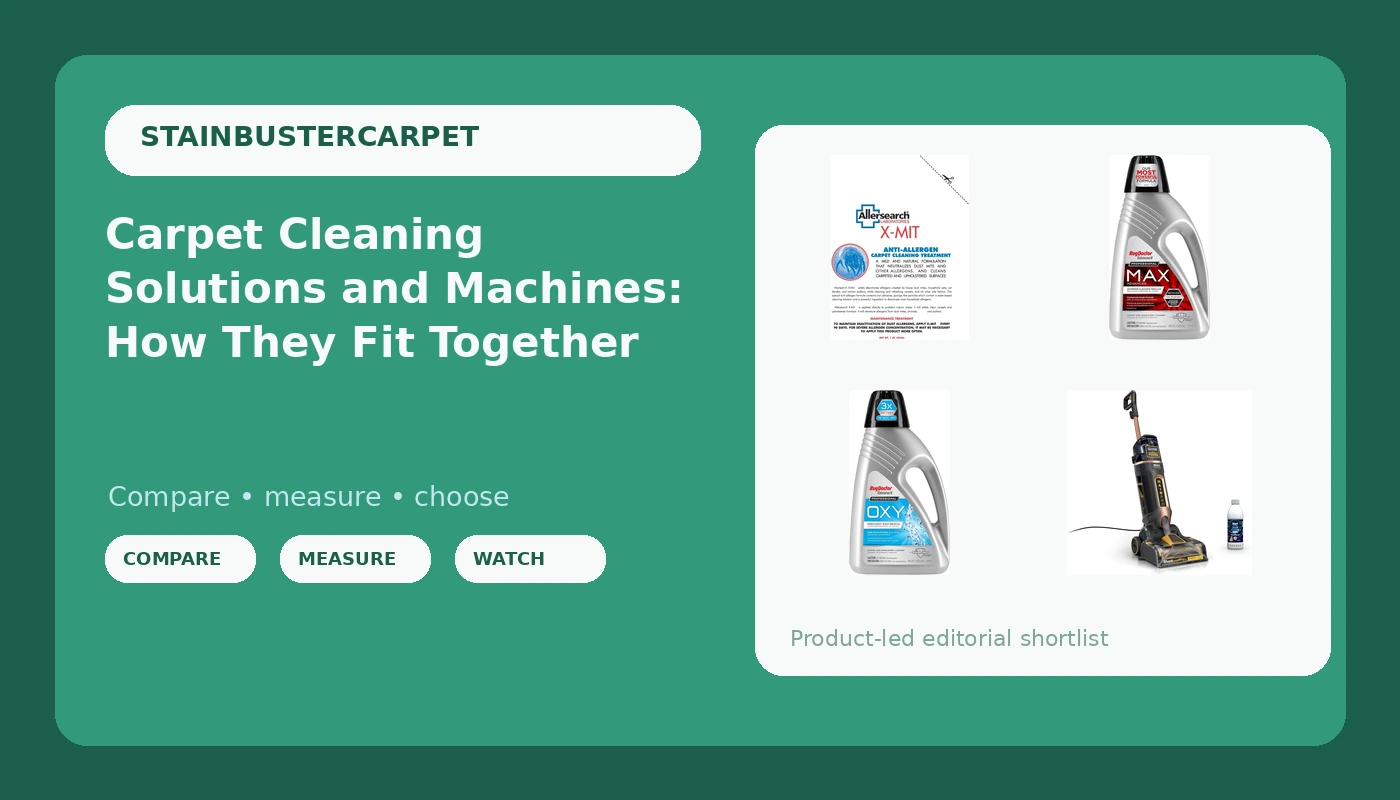
A carpet does not get clean because you bought a good machine. It gets clean because the machine, the chemistry, and the drying time all line up. That is the part most shoppers miss. The carpet cleaning solution you pour into the tank is not an accessory, it is half the system, and the two Rug Doctor by BISSELL formulas below are the clearest example of why. Pair a strong upright with a formula that foams and the carpet looks clean for a day and feels tacky for a week. Pair a mild product with years of traffic-lane soil and you will be disappointed in a slower way. The goal here is not to sell you the biggest setup. It is to show you which of these four pieces does the work you actually need done, so you buy once instead of three times.
Related: Upright vs Portable Carpet Cleaners: Which One Earns Its Storage Space →
Quick answer
A complete carpet cleaning setup has three parts: a machine that puts water down and pulls it back up, a solution matched to the soil you are fighting, and a drying plan. For whole rooms, that means an upright carpet cleaner plus a concentrated formula. If allergies are the reason you are cleaning, a dry anti-allergen powder handles the surface load without adding moisture. If spots and stains are the reason, an oxygen-based formula is the one to reach for.
4 useful options
| Model | Best fit | What stands out |
|---|---|---|
| Shark CarpetForce HairPro Lightweight Upright Carpet & Rug Cleaner, EX551 | Whole-room cleaning on carpet and rugs | Lightweight upright format with a hair-focused brush design |
| Allersearch X-Mit Anti-Allergen Carpet Cleaning Powder | Allergy-focused refresh with no water | Dry powder application, so no wet dry-time clock |
| Rug Doctor by BISSELL Max Advanced Commercial Carpet Cleaner Solution 48 oz | Heavy soil in machine-cleaned carpet | Concentrated 48 oz formula aimed at commercial-level soil |
| Rug Doctor by BISSELL Oxy Deep Carpet Cleaner Solution 48 oz | Stain-focused deep cleaning | Oxygen-based chemistry in a 48 oz bottle |
The machine: Shark CarpetForce HairPro Lightweight Upright Carpet & Rug Cleaner, EX551
Weight is a feature, not a footnote. A machine you dread hauling out of the closet gets used less, and a machine that gets used less cleans worse over a year than a modest one you actually deploy. A lightweight upright is a bet on frequency. The trade-off is real: lighter uprights generally carry less water per pass, so plan on more passes over the same traffic lane, and uprights are awkward on stairs and upholstery no matter how light they are. If your cleaning is mostly open carpet in a hallway, a living room, and a bedroom, this is the format that fits.
The dry option: Allersearch X-Mit Anti-Allergen Carpet Cleaning Powder
This is a different job than extraction, and it is worth being honest about that. A powder addresses what sits in and on the pile, the allergen load that gets stirred up every time someone walks through the room. It does not replace a wet cleaning that pulls soil out of the base of the carpet. Used as maintenance between wet cleanings, it is a sensible tool. Used as a substitute for extraction, it will disappoint. The upside is that it is the one option here you can use on a rainy week without turning a bedroom into a drying project.
The heavy-soil solution: Rug Doctor by BISSELL Max Advanced Commercial Carpet Cleaner Solution 48 oz
The cleaning solution is part of the machine. That sounds like a slogan until you do the arithmetic on a year of cleaning: a modest machine fed an expensive formula can cost more to run than a better machine fed a concentrate. Concentrates are also where people get themselves into trouble, because more is not better. Over-dosing a carpet cleaning solution is the most common cause of foam in the recovery tank and sticky residue left in the pile, and residue is a dirt magnet. Mix to the label, not to your instincts.
The stain solution: Rug Doctor by BISSELL Oxy Deep Carpet Cleaner Solution 48 oz
Oxygen chemistry works on contact time, which changes how you use it. If you run the machine over a stain and immediately move on, you have given the formula almost no chance to do anything. Slow passes, and a second pass on the bad spots, get more out of it. The other honest note: no formula removes every stain. Dye-based spills, bleach marks, and anything that has been set by heat are frequently permanent, and no bottle on this page changes that. What a good oxygen formula does is improve your odds on the stains that are still removable.
Prices and availability may change. Product images, names, and retailer links must be matched by verified ASIN. Do not state a current price, rating, stock status, or measured result without current evidence.
The solution is part of the machine
Carpet cleaning chemistry is not a generic commodity. Formulas differ in pH, in surfactant load, in how much they foam, and in whether they leave anything behind in the pile. Those differences matter more than the marketing language on the front of the bottle.
Start with dilution. Almost every machine-use formula is a concentrate, and the label ratio is not a suggestion. Under-diluting means you are paying for water; over-diluting means you are leaving surfactant behind. Residue is the enemy here, because a sticky pile grabs and holds soil faster than a clean one, which is why a carpet can look dingy again two weeks after a heavy cleaning. If your recovery tank foams up, that is a dosing problem, not a machine problem.
Then think about fiber. Most residential carpet today is some blend of synthetic fiber, and synthetic fiber is generally tolerant of the mild alkaline chemistry used in carpet cleaning solutions. Wool, viscose, and some natural fibers are not, and the fiber manufacturer's care guide always outranks the bottle label. If you do not know what your carpet is made of, find out before you mix anything.
Finally, think about cost per cleaning rather than cost per bottle. A 48 oz concentrate that dilutes heavily may run cheaper per room than a bargain bottle you have to use at full strength. The bottle size on the shelf tells you very little on its own.
Dry time is the specification nobody prints on the box
Every wet cleaning leaves water in the carpet, and the clock starts the moment the machine stops. Recovery, the rate at which the brush roll and suction lift water back out, is the number that decides how long that clock runs. It is also the number no box advertises, which is why the honest test is a simple one: weigh or eyeball the recovery tank before and after, and see how much actually came back out of the carpet.
Dry time matters because a carpet that stays damp for a day or two is a problem, not a result. Damp pile in a warm room is where odor and microbial growth get started, and once that happens you are cleaning for a different reason. Practical moves: run the machine in slow overlapping passes, go over the same area a second time with suction only, open windows or run a fan, and turn on air conditioning if you have it. In a dry climate, carpet can be walkable in a few hours. In a humid one, the same cleaning can take considerably longer, and no machine changes the weather.
This is also where the powder earns its place. On a week when the carpet cannot be wet, an anti-allergen powder reduces the surface load without starting a drying clock at all. It is maintenance, not extraction, but maintenance on a schedule beats a deep clean that never happens because the timing is never right.
- Measure the rooms you actually clean, not the whole house. Most people overbuy for a stairwell and a hallway.
- Identify the soil. Allergen load, traffic-lane grime, and fresh spots are three different problems.
- Decide whether water is allowed this week. If it is not, a powder is the only option that fits.
- Budget the solution alongside the machine. Running cost is part of the purchase price.
- Plan the dry before you start. Fans, airflow, and a second suction-only pass.
Matching the purchase to the job
- If your carpet is in open rooms and gets walked on daily, the machine and a concentrated solution are the core of the setup.
- If allergies drive your cleaning, keep an anti-allergen powder in the rotation and use it between wet cleanings.
- If you have one heavy traffic lane and a few bad spots, buy the heavy-soil concentrate for the lane and treat spots separately.
- If stains are your main complaint, an oxygen formula plus patience on contact time beats a stronger mix every time.
- If you are not sure what your carpet fiber is, check the manufacturer's care guidance before you use any formula at all.
Which option should you choose?
Choose the Shark CarpetForce HairPro Lightweight Upright Carpet & Rug Cleaner, EX551 when you are cleaning whole rooms of carpet and rugs and you want a machine light enough that hauling it out is not the reason the job gets postponed. Choose the Allersearch X-Mit Anti-Allergen Carpet Cleaning Powder when allergen load is the problem and you cannot or should not add moisture to the carpet right now. Choose the Rug Doctor by BISSELL Max Advanced Commercial Carpet Cleaner Solution 48 oz when the carpet has heavy, set-in traffic-lane soil and you want a concentrated formula built for machine use. Choose the Rug Doctor by BISSELL Oxy Deep Carpet Cleaner Solution 48 oz when spots and stains are what you are chasing and you are willing to slow down and let the chemistry work.
One caveat worth repeating: nothing on this page is a measurement. Recovery rates, dry times, and stain results depend on your machine, your carpet, your water, and your technique. Read the label, read your machine's manual, and treat the fiber manufacturer's guidance as the final word.
The bottom line
The machine and the solution are one decision, not two. A lightweight upright decides how often you clean; the formula decides how much of what you loosen actually leaves the carpet; and the drying plan decides whether you created a problem or solved one. If allergies are the reason you are cleaning at all, a dry powder belongs in the rotation. If heavy soil and stains are the reason, the two Rug Doctor by BISSELL formulas cover the two different jobs that "deep clean" usually means. Buy for the cleaning you actually do most often, and check the current Amazon price before you commit.