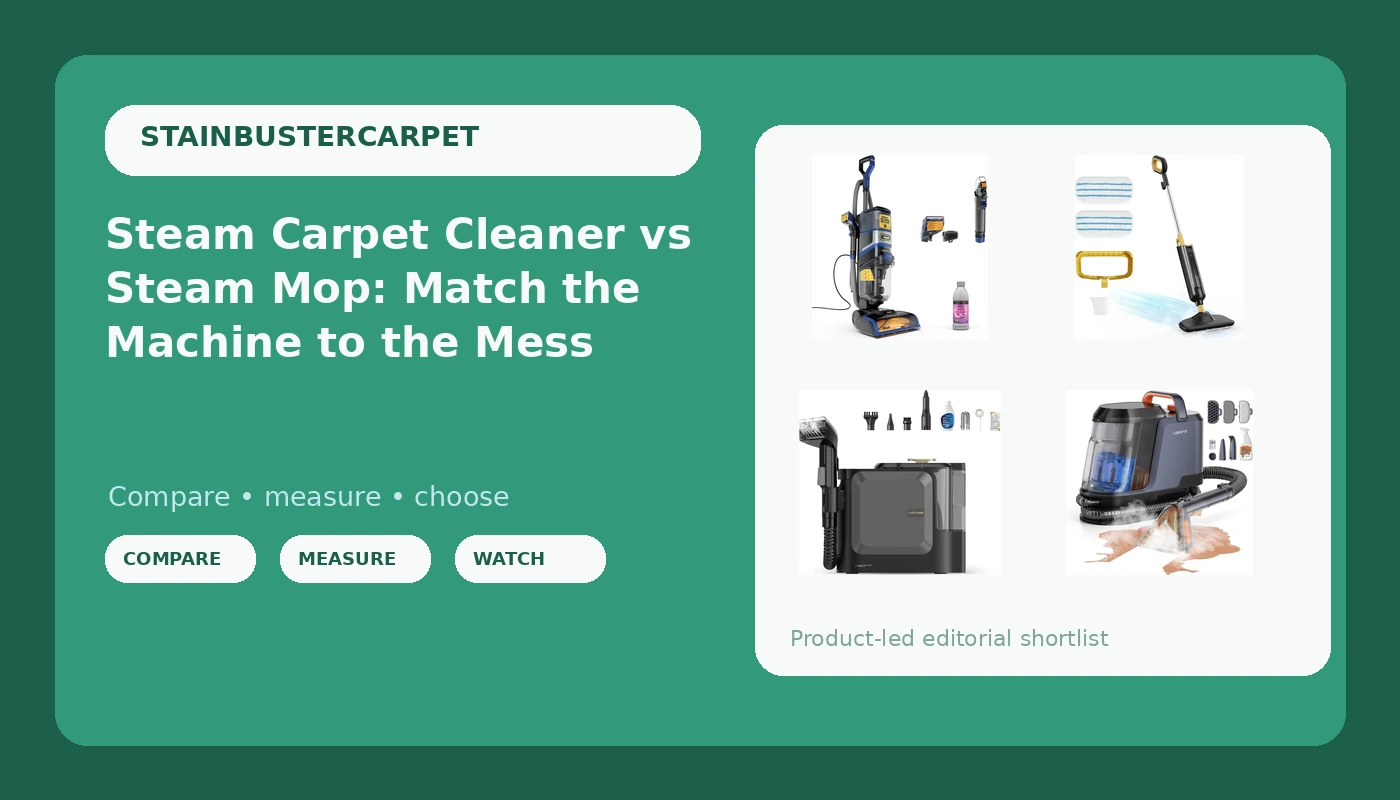
A steam carpet cleaner and a steam mop both make heat, and that is roughly where the similarity ends. One is built to put water or solution into carpet pile and pull the dirty water back out into a tank. The other turns water into vapor and glides it across a sealed hard floor. Buy the wrong one and you will either be scrubbing a grout line with an extractor or spending a Saturday steaming a carpet that never actually comes clean. The four machines below sit at different points on that map, from a lightweight steamer to a full upright extractor, and the choice between them comes down to two things: the surface under your feet and the kind of soil you are fighting.
Related: How to Read a Dirty-Water Tank Before You Buy →
Quick answer
Match the tool to the surface first. For wall-to-wall carpet, upholstery, and stairs, you want a machine that injects water or solution and recovers it into a dirty tank, because recovery is what carries suspended soil out of the fiber. For sealed hardwood, tile, and laminate, a steam mop is the lighter and simpler tool. Steam combined with hot water extraction, which the DREAME N20 and the Uwant machine both offer, covers carpet that needs heat without giving up recovery. The Shark CarpetXpert HairPro is the full upright option in this group for whole-room carpet and pet hair, while the NEWBULIG steam mop is the hard-floor and light-refresh tool.
Four useful options
| Model | Best fit | What stands out |
|---|---|---|
| Shark CarpetXpert HairPro Carpet & Built-in Stain Cleaner, 2 Tools EX251BRN | Whole-room carpet and pet hair | Full upright extractor with a built-in stain cleaner and two included tools |
| NEWBULIG Steam Mop for Hardwood/Tile/Carpet | Sealed hard floors plus light carpet refreshment | Heats up in 30 seconds, 16.4 ft cord, two washable pads |
| DREAME N20 Steam Carpet Cleaner Machine with Steam & Hot Water Wash | Carpet that needs heat and recovery together | Steam plus a hot water wash in one carpet cleaning machine |
| Uwant Carpet Cleaner Machine with Steam, Hot and Cold Water Modes | Mixed jobs, upholstery, and pet messes | Steam, hot, and cold water modes, 18 kPa rated suction, Pet Pro cleaner included |
The full upright: Shark CarpetXpert HairPro Carpet & Built-in Stain Cleaner, 2 Tools EX251BRN
This is the machine in the group that behaves like the uprights I use on client carpet. It walks the room with you, sprays and agitates, and pulls the water back into a tank you can see through. That tank is the whole point. When you finish a room and the dirty water is brown, you have evidence. When it comes out clear, you either have clean carpet or a machine that is not lifting anything, and the difference matters.
The trade-off with any full upright is weight and storage. It is the tool you commit to for a whole-room job, not the one you grab for a coffee spill at 7 a.m. If your carpet cleaning is mostly stairs, a car interior, and one couch cushion, a full-size upright is more machine than your biggest job needs.
The lightweight steamer: NEWBULIG Steam Mop for Hardwood/Tile/Carpet
Here is the honest boundary. A steam mop sanitizes and lifts light soil from sealed hard floors with very little water, which is exactly what you want on tile and finished hardwood. On carpet, a steam mop with a glider can refresh pile and flatten a smell, but it does not extract. There is no dirty-water tank because nothing is being recovered. Any soil the steam loosens is still in the carpet unless something pulls it out.
That is not a knock on the tool. It is a different tool for a different surface. If your home is mostly hard flooring with a few area rugs, this is the machine you will actually use weekly. If your home is wall-to-wall carpet, this is a supplement, not a solution.
The steam and hot water machine: DREAME N20 Steam Carpet Cleaner Machine with Steam & Hot Water Wash
Heat is not decoration. Warm water dissolves greasy and protein-based soil faster than cold water does, which is why the machines I trust most keep the water hot from the tank to the nozzle instead of losing it in a long hose. Steam adds a second lever: it works on the surface of the fiber and into the base of the pile without adding much liquid volume.
The trade-off is complexity. Two heat systems mean more to fill, more to empty, and more to maintain. It also sits in a middle category: more carpet-capable than a steam mop, less of a full upright workhorse than the Shark. For an apartment with a few carpeted rooms, that middle position can be exactly right.
The multi-temperature machine: Uwant Carpet Cleaner Machine with Steam, Hot and Cold Water Modes
Cold water has a real job. On wool, on some natural fibers, and on certain stains, heat sets the problem instead of lifting it. Protein stains from pets and food are the classic example: hot water can cook them into the fiber. Having a cold setting is not a gimmick, it is a safety valve for the wrong fiber or the wrong stain.
The trade-off is that a machine with three temperature modes asks you to know which one to pick, and the manual is the authority, not a guess. The upholstery framing also tells you where it is most comfortable: couches, mattresses, car seats, and stairs, which is where most portable and mid-size cleaning actually happens.
Prices and availability may change. Product images, names, and retailer links must be matched by verified ASIN. Do not state a current price, rating, stock status, or measured result without current evidence.
Steam mops and carpet cleaners are not the same tool
The single most common buying mistake in this category is treating "steam" as the defining word. It is not. The defining question is whether the machine recovers what it loosens.
A steam mop heats water past boiling and releases vapor through a pad. Moisture is low, dwell time is short, and the pad wipes the surface. On sealed tile and finished hardwood, that is a clean, fast, chemical-free routine. On carpet, the vapor reaches the top of the pile and stops. Nothing carries the loosened soil away.
A carpet cleaner or extractor sprays water or solution into the pile, agitates it with a brush, and then applies suction to pull the liquid back into a recovery tank. That recovery step is the cleaning. It is also why a dirty tank is the most honest specification on the box: it is a physical record of what left your carpet.
Some machines, including two in this group, combine both approaches. Steam does surface work and adds heat; extraction does the removal. That combination is genuinely useful, but it does not turn a steamer into an extractor, and it does not turn a light extractor into a truck-mounted unit.
Dry time and the dirty-water tank
Ask two questions about any carpet machine before you look at anything else.
First, how much water does it leave behind? A machine with strong airflow and a well-sealed nozzle leaves the pile damp rather than soaked. A machine that over-sprays leaves the carpet wet for a day or more, and a carpet that stays damp is a problem, not a result. Wet backing and wet pad are how you get odor and worse. Fans, open windows, and running the air conditioning all shorten the clock, and two dry passes with no spray do more for dry time than any single feature on the spec sheet.
Second, how easy is the tank to empty and rinse? If the dirty tank is awkward, you will skip rinsing it, and a tank with residue in it smells like a wet dog within a week. The same goes for the clean tank and the solution line. A machine that is annoying to maintain gets maintained badly.
The professional habit worth stealing: look at what comes out, not at what the carpet looks like while it is still wet. Wet carpet hides soil. Once it dries, the wicking starts, and whatever was left in the pad comes back to the surface.
Reading the numbers that actually change the job
Suction ratings deserve skepticism. A kilopascal number is measured under specific conditions at a specific point, and it does not translate directly into how much water a nozzle lifts off a carpet. Airflow, nozzle seal, brush speed, and pass speed all matter more in the room than the number on the listing. Treat the figure as one data point, not a ranking.
Heat-up time matters more than people expect. The NEWBULIG listing states 30 seconds, which is the difference between using a tool and waiting for one. Cord length matters for the same reason: 16.4 ft of cord determines how many times you unplug and move.
Then there is the cost nobody puts on the box. Cleaning solution is part of the machine. A budget unit that demands expensive proprietary formula is not a budget unit after two years. Check whether the manufacturer allows a general-purpose carpet solution, and always match the formula to the fiber and to the machine's foam tolerance, because a solution that foams leaves residue that attracts dirt back.
Five steps to choose before you buy
- List the surfaces in your home by square footage: sealed hard floor, carpet, rugs, upholstery, stairs. The biggest surface decides the category.
- Name the soil. Pet accidents, tracked-in dirt, food spills, and traffic lanes each respond to different temperatures and dwell times.
- Decide whether you need recovery or just heat. No dirty-water tank means no extraction, no matter how much steam it makes.
- Check the practical specs: tank size against your largest room, cord length against your floor plan, and weight against the stairs you have to carry it up.
- Read the maintenance routine before you buy, including filter cleaning, tank rinsing, and how often pads or brushes need replacing.
Practical guidance that saves carpet
- Buy for your biggest cleaning job, not your ideal one. Most people overbuy for a stairwell and underbuy for a living room.
- Vacuum dry first. Extraction on top of loose debris turns dust into mud in the pile.
- Pre-treat traffic lanes and spots and give the solution dwell time before you extract.
- Make two dry passes with no spray at the end of every section. Dry time is the spec everyone ignores until the carpet smells.
- Empty, rinse, and air-dry both tanks after every use, and never store a machine with solution sitting in the line.
- Test any solution on a hidden corner first, and keep a fan moving air through the room afterward.
Which option should you choose?
Choose the Shark CarpetXpert HairPro Carpet & Built-in Stain Cleaner, 2 Tools EX251BRN when your home is mostly wall-to-wall carpet, you have pets, and you want one upright that handles a whole room plus the stairs with its included tools. Choose the NEWBULIG Steam Mop for Hardwood/Tile/Carpet when your floors are mostly sealed hardwood and tile, you want fast chemical-free routine cleaning, and carpet is limited to light refreshment. Choose the DREAME N20 Steam Carpet Cleaner Machine with Steam & Hot Water Wash when carpet is the priority and you want heat in the cleaning path without the bulk of a full upright. Choose the Uwant Carpet Cleaner Machine with Steam, Hot and Cold Water Modes when your messes are on upholstery and stairs, pets are involved, and you want the option to drop to cold water for fibers or stains that heat would set.
The limitation worth stating plainly: none of this replaces fiber knowledge. Manufacturer care guides and the machine manual outrank any buying article, including this one. And no machine removes every stain. Some marks are furniture now, and the sooner you accept that, the less time you spend re-wetting a carpet that has already given you its answer.
The bottom line
Steam is a feature, not a category. If you need soil removed from carpet, you need recovery, and that means a dirty-water tank and a machine built to fill it. If you need clean sealed hard floors with minimal water, a steam mop is the lighter, faster, more sensible tool. Read the tank, weigh the dry time, check the weight you have to carry, and buy for the room you actually clean most often. Check current Amazon price on each option and let your floor plan, not the marketing copy, make the call.