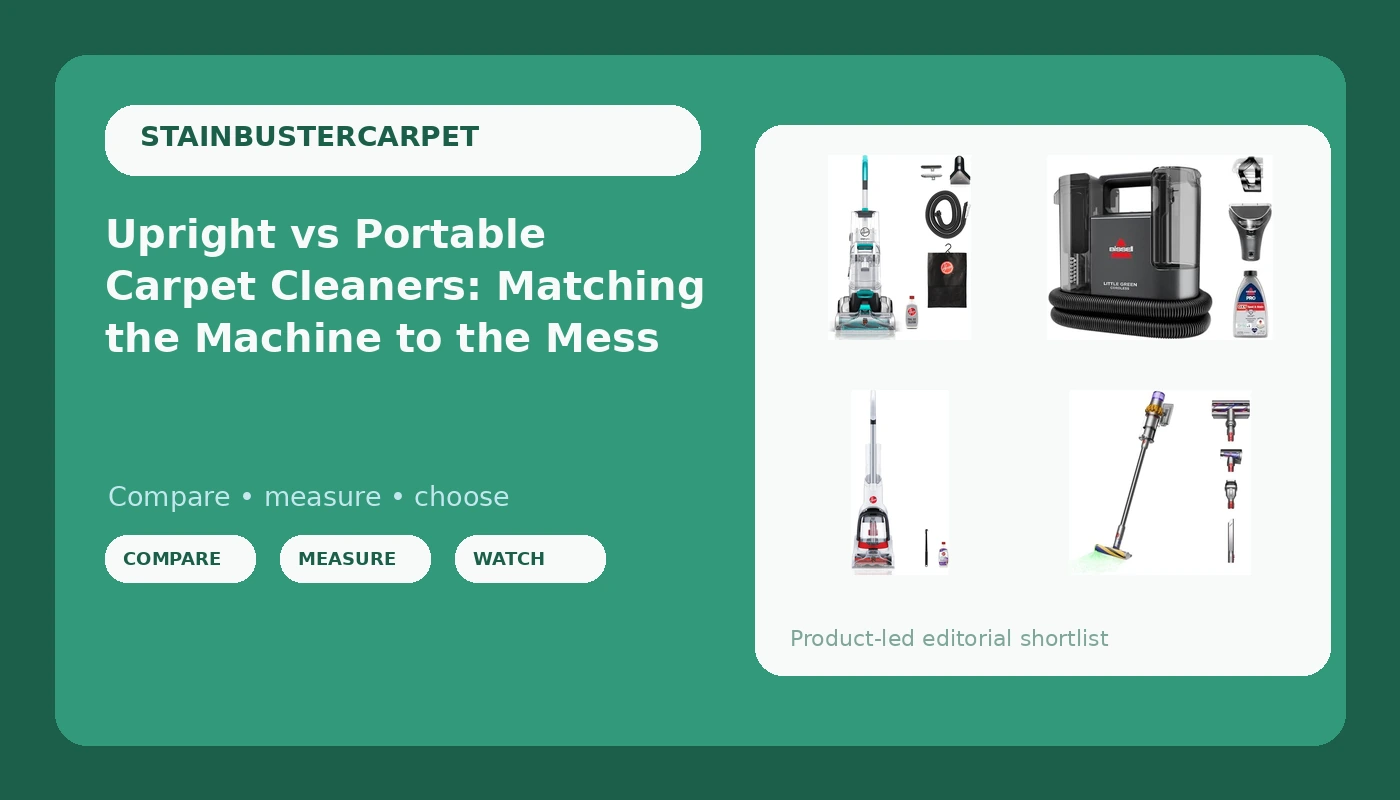
Most carpet cleaning advice opens with suction numbers and ends with a machine that lives in the garage. The more useful question is narrower: what is the biggest mess in your home, and where does it sit? Traffic lanes in a living room, a stairwell, a couch cushion, a car trunk, and a hallway all have different shapes, and that is why the upright vs portable carpet cleaners question keeps coming back. A full-size upright shampooer is built for open floor and volume. A portable spot cleaner is built for edges, stairs, and upholstery where a full-size machine physically cannot go. A cordless vacuum handles the dry half of the job that has to happen before any water touches the fiber. Get the roles straight and the shopping list gets much shorter.
Related: How to Read a Dirty-Water Tank: What Your Cleaner Actually Removed →
Quick answer
Wet extraction and dry vacuuming are different jobs, so the honest answer is that many homes need two tools rather than one. For whole rooms, choose a full-size upright extractor with automatic solution mixing and a dirty tank you can carry to the sink. For stairs, upholstery, and small spills, choose a portable spot cleaner. For dry debris, pet hair, and crumbs before you shampoo, choose a cordless vacuum. Buy for the largest job you actually have, not the one you imagine having.
Four useful options
| Model | Best fit | What stands out |
|---|---|---|
| Hoover SmartWash Automatic Carpet Cleaner, FH52000 (Renewed) | Whole-room cleaning with minimal setup | Automatic solution mixing in a full-size upright format |
| BISSELL Little Green Cordless Portable Carpet Cleaner, 3682 | Stairs, upholstery, and small spills | Cordless portable spot cleaning in the Little Green line |
| Hoover PowerDash Pet+ Compact Carpet Cleaner | Pet households with limited storage | Compact, lightweight upright shampooer format |
| Dyson V15 Detect Cordless Vacuum Cleaner, Yellow/Nickel | Dry pickup before and between shampoos | Cordless stick vacuum with detection features |
Whole rooms: Hoover SmartWash Automatic Carpet Cleaner, FH52000 (Renewed)
Uprights win on volume. You push forward, you pull back, and the brush roll and suction do the work across a wide path, which is why they handle a living room faster than any portable. The trade-offs are the ones people forget: storage footprint, weight, a cord that finds every furniture leg, and the fact that you have to move things out of the way before you start. A renewed unit changes the math on price, but it also moves the risk to the listing, so read what is actually included. Automatic mixing matters more than it sounds, because inconsistent dilution is one of the most common ways a homeowner either wastes solution or leaves residue behind.
Stairs and upholstery: BISSELL Little Green Cordless Portable Carpet Cleaner, 3682
Portables exist because geometry beats power. A twelve-inch upright head does not fit on a stair tread, and dragging a full-size machine up a staircase is how backs get hurt. The honest trade-off with a cordless portable is capacity and runtime: you will empty the dirty tank and refill the clean tank more often than you would with an upright, and battery charge sets the pace. That is fine if you plan around it. Treat a staircase as several short passes rather than one long session, dump and rinse the tank between flights, and the small tanks stop being a problem and start being a reason the machine gets used at all.
Pet households: Hoover PowerDash Pet+ Compact Carpet Cleaner
Weight is a feature, not a footnote. A machine that is easy to lift out of a closet and carry up a flight of stairs gets used on a Tuesday afternoon spill. A machine that requires a scheduled production gets used twice a year, and carpet that is cleaned twice a year looks like carpet that is cleaned twice a year. The compact class trades tank volume for that convenience, so expect more refill stops on a large room. If your floor plan is one apartment, one hallway, and a pet bed by the window, that trade is a good one. If you have three bedrooms of open carpet, it is not.
Dry pickup: Dyson V15 Detect Cordless Vacuum Cleaner, Yellow/Nickel
This is where buying guides tend to blur categories. A vacuum, a steam mop, and a wet extractor are three different tools, and only one of them is a carpet cleaner in the shampoo-and-rinse sense. A stick vacuum does not pull water out of a carpet and it does not replace extraction. What it does is handle the dry half of the job, and that half is bigger than most people think. Pet hair, tracked-in grit, and crumbs sit on top of the fiber. If you go straight to a wet pass, you are wetting that layer and working it in. Vacuum first and the extractor's dirty tank has less to fight through.
Prices and availability may change. Product images, names, and retailer links are matched to verified listings. No current price, rating, stock status, or measured result is stated here without current evidence.
What the dirty-water tank actually tells you
The dirty-water tank is the honest spec. Marketing copy talks about suction and brush speed, but the tank holds the physical evidence of what the machine removed, and it is the one number you can check yourself. A machine that leaves the tank nearly clear on a visibly soiled carpet did not clean; it just made the carpet damp. Before and after weight on that tank tells you more about recovery than any spec sheet line, because water left behind in the carpet is both the cleaning result and the drying problem.
Tank design also decides whether you will keep using the machine. A dirty tank with a wide mouth and a pour spout that clears the opening is easy to empty into a utility sink or a toilet. A tank with a narrow neck and a gasket that traps debris is a chore you will start avoiding. Two-tank systems, where clean and dirty water stay separate, keep you from pouring dirty water back through the carpet, which is the whole point of extraction. Check how the tank opens and how it seals before you buy, not after.
Why dry time beats suction specs
A carpet that stays wet for two days is not a clean carpet, it is a mold project with a nicer name. Dry time is the spec nobody prints, and it depends on how much water the machine leaves behind, how much airflow the room gets, and how many dry passes you are willing to make after the wet ones. In a dry climate, a carpet can be walkable in a few hours with a fan and an open window. In a humid house with the windows shut, the same machine can leave the same carpet damp overnight.
The practical lever is passes. Most people run wet pass after wet pass, then stop. Running additional dry-only passes after the last wet pass pulls more water into the tank and shortens the window considerably. Pair that with a box fan aimed across the carpet and the difference is measurable. Suction ratings on a box do not tell you how long your floor stays wet. Your own clock does, and it is the only number that matters for whether you can walk on it before dinner.
- Identify the single largest cleaning job in your home, because that is what the machine has to handle.
- Measure where the machine will live, since storage decides how often it comes out.
- Decide whether your first problem is dry debris or wet staining, and buy that tool first.
- Check the dirty tank's opening and seal, because that is your daily interaction with the machine.
- Add up solution and accessory costs, since a cheap machine with expensive consumables is not cheap.
Practical guidance before you buy
- Vacuum thoroughly first. Wet cleaning over dry soil pushes grit deeper into the pile.
- Test any solution on an inconspicuous corner for colorfastness before you commit to a whole room.
- Mix solution at the label dilution. Stronger is not cleaner, and residue attracts new dirt.
- Empty and rinse the dirty tank after every use, then let it air dry with the lid off.
- Plan airflow before you start: a fan and an open window do more for dry time than another wet pass.
Which option should you choose?
Choose the Hoover SmartWash Automatic Carpet Cleaner, FH52000 (Renewed) when your main job is whole rooms and you want the solution mixing handled for you. Choose the BISSELL Little Green Cordless Portable Carpet Cleaner, 3682 when stairs, upholstery, and small spills are the messes you actually face. Choose the Hoover PowerDash Pet+ Compact Carpet Cleaner when you have pets, limited storage, and a smaller floor plan. Choose the Dyson V15 Detect Cordless Vacuum Cleaner, Yellow/Nickel when you need the dry pickup step covered before and between shampoos.
One caveat worth stating plainly: no machine removes every stain. Some stains are permanent, some are dye damage rather than soil, and some carpets are simply at the end of their life. A renewed listing also carries its own terms, so confirm what the seller includes. If a stain has already set for years, a cleaning pass may lighten it without erasing it, and that is a normal result rather than a machine failure.
The bottom line
The upright vs portable carpet cleaners decision comes down to geometry and volume, not brand loyalty. Full-size uprights cover open floor and handle the dirty water in larger batches. Portables reach the stairs, the couch, and the car, which is where most stains actually happen. A cordless vacuum covers the dry half of the job and keeps the wet pass from grinding loose soil into the fiber. Most homes end up with a vacuum plus one wet machine, chosen for the biggest job they truly have. Match the tool to the mess in front of you, measure your dirty water, and watch your dry time. Those three habits do more for a carpet than any spec on a box.