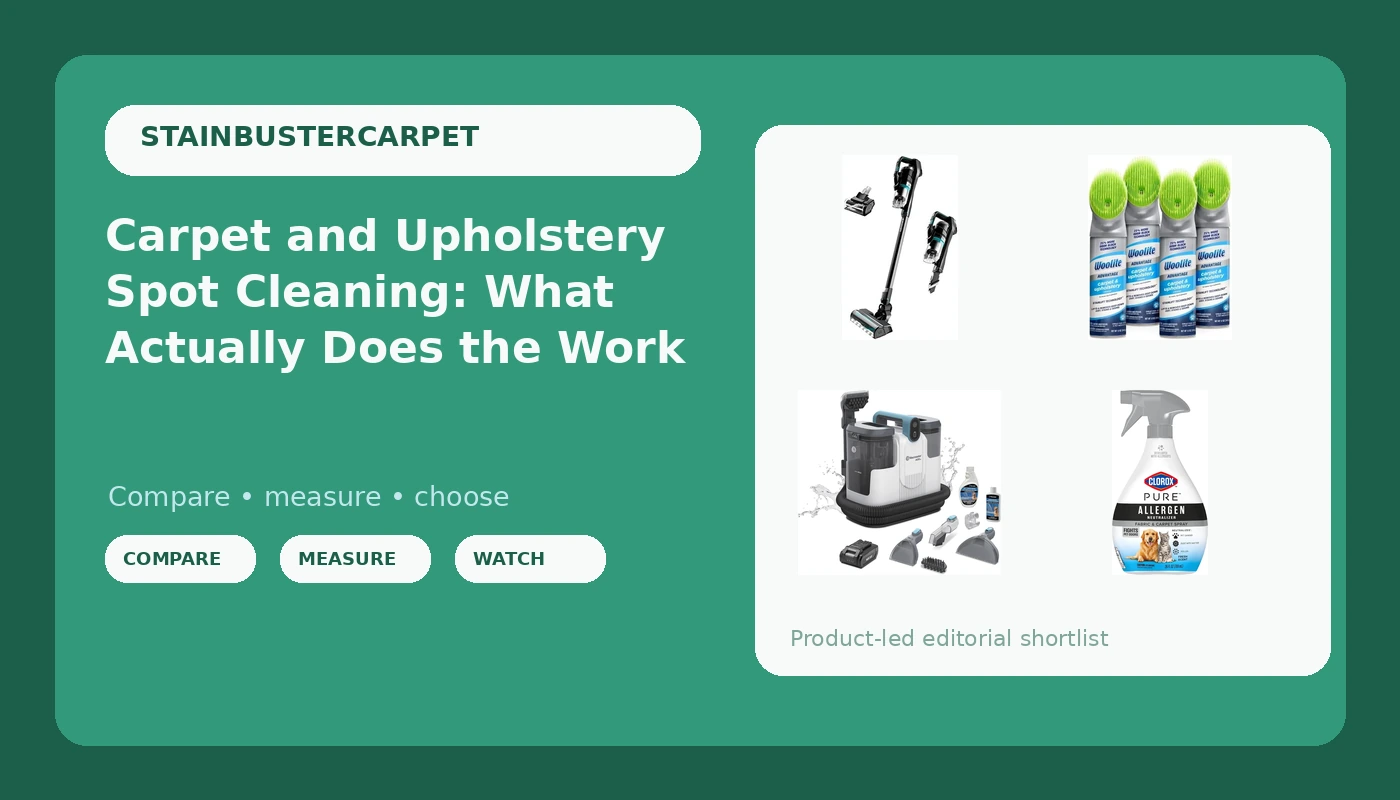
You notice the stain on a Tuesday. By Saturday there is a spray bottle, a jug of solution, and a machine you have never switched on, and nothing on any label explains which one does which part of the job. Carpet and upholstery spot cleaning is a sequence, not a single purchase. Dry soil comes out first. Chemistry goes on next. Moisture comes back out. Odor gets handled on its own schedule, because a smell is a different problem from a stain.
This explainer separates that sequence into four roles and matches one product to each role: a cordless extraction machine, a carpet and upholstery cleaning solution, an allergen and odor spray, and a dry vacuum for the prep step. Nothing below is a ranking. It is a map of what each item actually does, so you can buy the stage you are missing instead of the whole shelf.
Related: Cordless vs Corded Carpet Cleaners: Which Setup Fits Your Home →
Quick answer
Most spots resolve in four stages: lift dry debris with a vacuum, apply a carpet and upholstery cleaning solution, extract the moisture with a machine that has a dirty water tank you can inspect, then treat odor with a spray made for fabric. The Vacmaster 600 Series Cordless Portable Carpet & Upholstery Cleaner Machine covers extraction, the BISSELL Woolite Advantage 4 pack supplies the solution, the Clorox PURE Allergen Neutralizer handles odor and allergens, and the BISSELL ICONpet cordless vacuum covers dry prep. Buy the stage you are missing, not the whole shelf.
Four useful options
| Model | Best fit | What stands out |
|---|---|---|
| Vacmaster 600 Series Cordless Portable Carpet & Upholstery Cleaner Machine | Spots, stairs, and upholstery | Cordless portable extraction built for carpet and upholstery |
| BISSELL Woolite Advantage Carpet & Upholstery Cleaner 4 Pack | Refilling a machine or pretreating by hand | Four bottles of carpet and upholstery cleaning solution |
| Clorox PURE Allergen Neutralizer Fabric and Carpet Spray | Odor and allergen follow-up on fabric | Spray format aimed at pet odors, fresh scent, 26 fluid ounces |
| BISSELL ICONpet Cordless Stick and Hand Vacuum | Dry debris before any liquid touches the fiber | Tangle free brushroll and SmartSeal filtration in a lightweight cordless vacuum |
The extraction stage: Vacmaster 600 Series Cordless Portable Carpet & Upholstery Cleaner Machine
Extraction is the stage most people skip, and it is the stage that decides how long the carpet stays wet. A cleaner that puts solution down without pulling it back up leaves the fiber damp, and a damp carpet is a problem rather than a result. The reason the dirty water tank matters more than any number on the box is simple: it is the only part of the machine that shows you what came out of the carpet. If the tank comes back clear, nothing was recovered, no matter how loud the motor sounded.
The trade-off with a cordless portable is capacity and runtime. A portable machine is easier to carry up a staircase than a full-size upright, but it holds less water, so an open living room means more refills and more passes. Cordless also means battery planning belongs in your routine. If most of your cleaning is a stairwell, a hallway runner, and a couch, the portable format matches the work. If it is three bedrooms and a great room, a full-size upright will cover the same area with fewer trips to the sink.
The chemistry stage: BISSELL Woolite Advantage Carpet & Upholstery Cleaner 4 Pack
The solution is part of the machine, whether or not the packaging admits it. A cheap machine fed with the wrong chemistry will leave residue behind, and residue is sticky. Sticky fiber collects new soil faster, which is why a carpet can look duller two weeks after a cleaning than it did before. Whatever you pour into the tank, mix it at the ratio the label states. A stronger mix is not a stronger clean. Over-concentrated solution is one of the most common reasons a carpet foams up inside the tank, and foam does not extract.
The trade-off with a four bottle pack is commitment. You get a lower cost per bottle and fewer reorders, but you are locked into one formula for a while. That matters if your home has more than one fiber type. Wool, for example, behaves differently from a synthetic loop pile, and fiber manufacturers publish their own care guidance for a reason. Read the care guide for anything you did not buy yourself before you commit a whole pack to it.
The odor stage: Clorox PURE Allergen Neutralizer Fabric and Carpet Spray
Odor is not the same problem as a stain, and treating it like one wastes water. A pet accident soaks past the fiber into the backing and sometimes into the pad, and a spray only reaches what it touches. That is the honest limitation of any surface spray. It is useful for freshening upholstery, for a light odor on a rug, and for the follow-up pass after extraction, but it will not flush contamination that has already sunk below the surface. For that, you need extraction first, and sometimes the pad itself is the answer.
The trade-off is sequence, not quality. If you spray first and extract after, you have spent product on a surface you are about to rinse. If you extract first and spray after the fiber is dry, the spray stays where you put it and does its job on the odor that remains. Used in that order, a spray is a genuinely separate tool rather than a substitute for cleaning.
The prep stage: BISSELL ICONpet Cordless with Tangle Free Brushroll
A dry vacuum and a carpet cleaner are two different tools, and mixing them up is how people end up disappointed. The ICONpet removes dry soil, hair, and crumbs. It does not put liquid into fiber, and it does not pull liquid out. Its job in the sequence is the first step: whatever dry material you leave on the carpet becomes mud the moment solution hits it, and mud works its way deeper instead of lifting out.
The trade-off is that this is a maintenance tool, not a stain solution. It earns its place if you have pets or long hair in the house, because a tangle free brushroll reduces the wrapping and cutting that makes daily vacuuming a chore. It will not rescue a set-in stain. Nobody should buy it expecting that.
Prices and availability may change. Product images, names, and retailer links must be matched by verified ASIN. Do not state a current price, rating, stock status, or measured result without current evidence.
How extraction actually works
Extraction cleaning is a two-part action that happens in one pass. The machine applies heated or room-temperature solution to the fiber, and immediately behind it a nozzle and brush roll lift the loosened soil and the liquid back into a recovery tank. The important variable is not the suction number printed on the box. It is recovery, meaning how much of the liquid you put down actually comes back up.
That is why the dirty water tank is the honest specification. It shows the difference between a carpet that was rinsed and a carpet that was soaked. A machine that leaves fiber wet for two days is not cleaning faster, it is creating a moisture problem under the surface where you cannot see it. Air movement, a fan, and open windows do more for dry time than any setting on the machine.
Two more details worth knowing before you buy anything. First, most cleaning solution does not need to be scrubbed in. Agitation helps, but scrubbing a stain aggressively can push it deeper and can fuzz the fiber surface. Second, hot water does not fix every stain. Protein stains behave differently from tannin stains, and some dyes are simply permanent. A realistic goal is improvement and odor control, not a guarantee of invisible results.
Where solution and spray fit in
Solution and spray are not competing products. Solution is designed to go into a machine tank or onto fiber as a pretreatment before extraction. Spray is designed for surface treatment after the fiber is dry. Using them in the wrong order wastes product and can leave residue that attracts new dirt.
Watch for foam. If a tank fills with suds, the machine cannot recover liquid properly, and you will find yourself emptying a tank full of air. Follow the stated dilution, and if a carpet has been cleaned repeatedly, consider whether the residue you are fighting came from the previous cleaning rather than this one.
- Identify what the soil actually is: dry debris, a protein spill, a tannin stain like coffee or tea, an oil-based mark, or odor only.
- Identify the fiber before any liquid touches it. Check the manufacturer's care guidance, especially for wool or anything hand-tufted.
- Match the tool to the area. Stairs, cars, and upholstery favor a portable; open rooms favor a full-size upright.
- Decide whether you need extraction at all. Some jobs are dry prep plus a fabric spray, and nothing else.
- Plan the dry time before you start, including airflow, so the carpet is walkable on your schedule rather than the machine's.
Practical guidance
- Vacuum the area dry first, every time. Dry soil left in place turns into mud under solution.
- Pretreat and let the solution dwell. Give it a few minutes to work before you extract.
- Mix solution at the ratio the label states. More concentrate means more residue, not more cleaning.
- Empty and rinse the recovery tank after each use, and let the tank and brush dry fully before storing.
- Keep a separate fabric spray for odor instead of over-wetting the same spot repeatedly.
- Test any liquid on a hidden area of the same fiber before you treat a visible one.
Which option should you choose?
Choose the Vacmaster 600 Series Cordless Portable Carpet & Upholstery Cleaner Machine when you need to put solution down and pull moisture back out, especially on stairs, a couch, or a small rug where a cord is a nuisance. Choose the BISSELL Woolite Advantage Carpet & Upholstery Cleaner 4 Pack when you already own a machine and want solution stocked for repeated sessions, or when you prefer to pretreat by hand before extracting. Choose the Clorox PURE Allergen Neutralizer Fabric and Carpet Spray when the problem is odor or allergens on fabric rather than visible soil, and you want a surface treatment for after the fiber dries. Choose the BISSELL ICONpet Cordless with Tangle Free Brushroll when the missing piece is daily dry pickup, particularly in a home with pets or long hair.
One caveat worth repeating: no product removes every stain. Dyes, older accidents that have reached the pad, and damage from a previous over-wetting may not come out, and some discoloration is permanent. Match your expectations to the fiber and the age of the stain, not to the marketing copy.
The bottom line
Carpet and upholstery spot cleaning works best when you stop looking for one product that does everything and start thinking in stages. Dry prep removes what water would turn into mud. Solution lifts the soil. Extraction pulls the moisture back out and tells you the truth through the dirty water tank. A fabric spray handles the odor that outlasts the stain. The four items here cover those stages, and the right purchase is usually the stage you do not already own. Start with the stage that matches your biggest recurring job, whether that is a staircase, a pet, or a whole room of carpet, and add from there.