Most carpet problems in a real house are not whole-room problems. They are a coffee ring beside the couch, a gray traffic lane at the bottom of the stairs, a pet accident that soaked through to the cushion, and a back seat that smells like wet dog after a hike. A portable carpet spot cleaner is the tool built for that list, and it is the tool most people skip because they assume they need a big upright first.
I have cleaned carpets for a living in Phoenix for fifteen years and ran my own residential cleaning business for eight of them. Here is the part that matters for your money: the machine that gets used is the machine that comes out of the closet without a debate. A heavy upright with a hose that has to be assembled gets used twice a year. A portable you can carry in one hand gets used on a Tuesday night when the dog throws up on the rug.
This is the order of operations I run on client carpets, plus the two pieces of gear I would buy first for stairs, couches, and cars.
Why you should trust me
I have pulled dirty water out of rentals, new builds, and houses where the previous owner kept three cats. I have cleaned the same staircase twice in one week because a client's puppy was not house trained yet. Fifteen years of that teaches you which machines are honest and which ones are a wet brush in a plastic shell.
My rule for every machine is the same, and it never changes. Weigh the dirty water tank before and after a job. Time the dry with a clock. Lift the machine the way a tired person would at the end of a long day. Those three checks decide more than any spec sheet.
The dirty water tank is the honest spec. If it comes out nearly clear, the machine moved water around and picked up almost nothing. Dry time is the spec everyone ignores until the carpet smells like a wet basement two days later. And weight is a feature, not a compromise. A machine that hurts your back stays in the garage, and a machine in the garage cleans nothing.
I do not believe in magic. I believe in lifting water back out of fiber, and in drying what is left before it becomes a problem.
How I picked and how I tested
This is not a whole-room buying guide. It is the short list for the jobs that make people call me: stairs, couches, car interiors, pet accidents, and the one mystery spot in front of the refrigerator.
The machine has to pass a short set of requirements before I would carry it into anyone's house. It has to be light enough to carry up a staircase with one hand while the other hand holds a towel. It has to have a hose and a hand tool, because the entire point is upholstery, edges, and the sides of the stairs where a wide cleaning path cannot reach. It has to have a dirty water tank you can empty without spilling it down your shirt, which rules out more designs than you would think. Suction on the box matters less than whether the machine can lift water back out of the fiber and hold it in the tank.
The solution has to be formulated for a machine, not for a mop bucket. Foaming solution is a real problem, because foam fills the recovery tank with air instead of water and you end up with a machine that stops pulling. A solution made for carpet cleaning machines, dosed at the label rate, is the only kind I put in a tank.
Every unit I evaluate gets the same three checks: dirty water, dry time, weight. I will not publish a dirty water number for a machine I have not run across a real stain, so what follows is the product record plus the exact checks I would run on day one before trusting either item with a client's carpet.
What you need before you start
Two things, and you can skip the rest until you have both. The machine does the work, and the solution decides how much residue stays behind to attract new dirt next month.
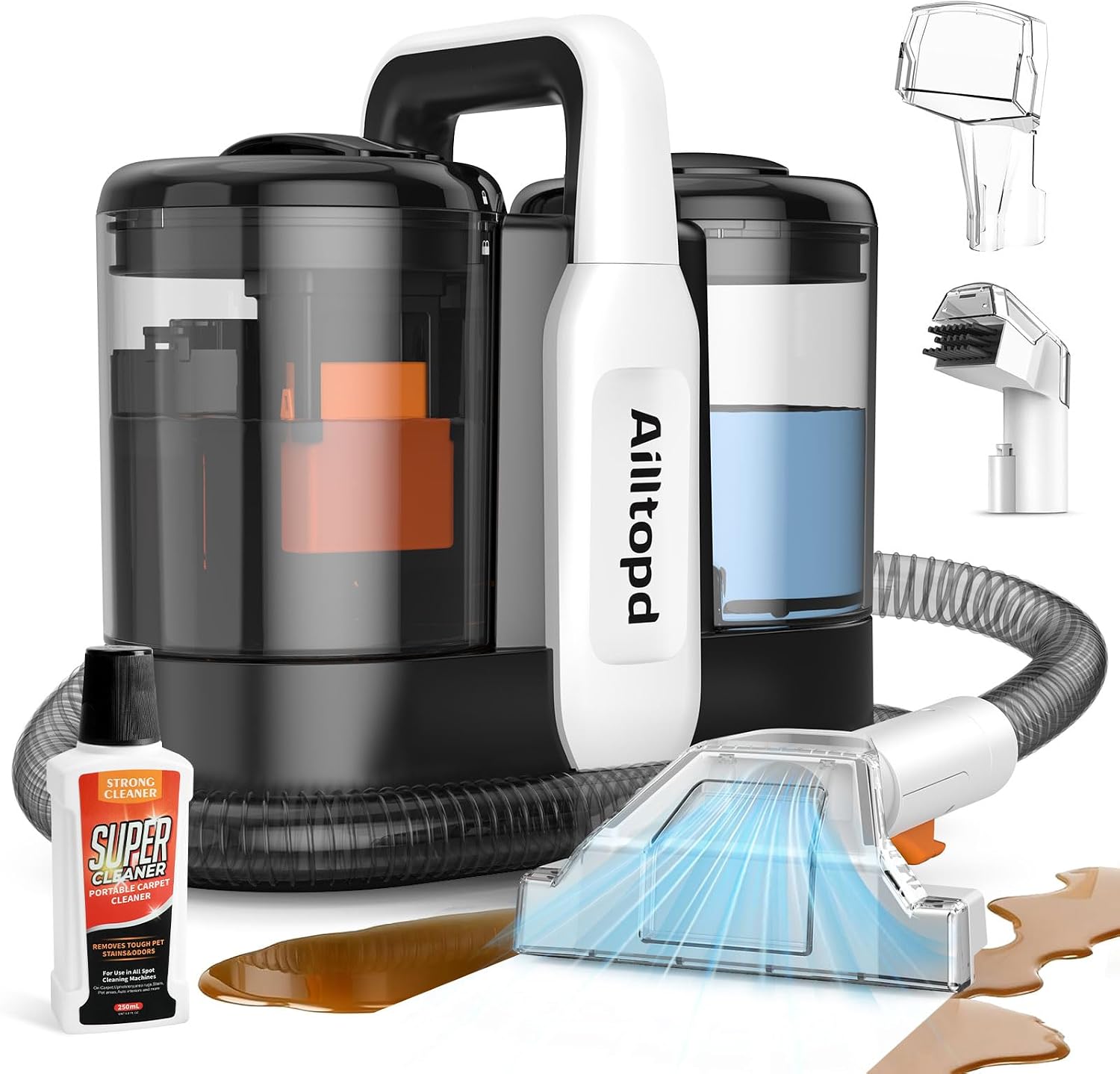
The machine: Ailltopd Portable Carpet & Upholstery Spot Cleaner Machine, 15Kpa Powerful Suction & Couch Cleaner, Deep Cleaning for Carpet, Car, Pets, Stairs, Furniture, Self Cleaning System and Cleaner Solution
 Visit on Amazon →
This is the portable for the jobs a full-size upright cannot reach. The listing calls out 15Kpa of suction, a self cleaning system, and a cleaner solution included in the box, and it names the exact work I get paid for: carpet, car interiors, pets, stairs, and furniture. Check current Amazon price.
The self cleaning system is the feature I would pay attention to. After a pet accident, the inside of the hose and the hand tool are the dirtiest parts of the machine, and a machine that can rinse its own internal path saves you the worst ten minutes of the job. The 15Kpa number is the headliner, but what I actually want to know is how quickly the hand tool pulls the water back out of the cushion and how much of it lands in the tank instead of the floor.
Before I would trust it, I would run my three checks. Fill the tank, run the hand tool over a measured stain, and weigh the dirty tank before and after. Then time the dry with a clock on the cushion, not just the carpet. Then carry it up and down a flight of stairs twice and see whether my shoulder complains.
Flaws but not dealbreakers: Portables in this class have small tanks, so plan on a few trips to the sink for a couch and more than a few for a staircase. The solution in the box is enough to start, not enough to finish a house. Neither of those is a reason to skip it, because the alternative is not cleaning the stairs at all.
Anyone in an apartment, a rental, or a two-story house with pets will get the most out of this class of machine.
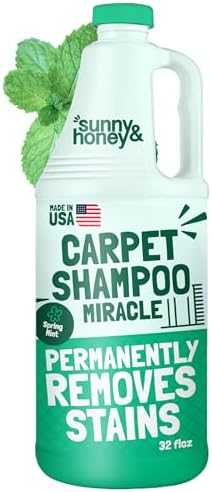
The solution: Sunny & Honey Carpet Cleaner Shampoo Solution for Machines, 32floz Mint
 Visit on Amazon →
Machine-ready solution is not glamorous, and it is the difference between a carpet that stays clean for a month and one that gets grimy again in a week. This one is made for carpet cleaning machines, comes in a 32 fluid ounce bottle, and carries a mint scent. Check current Amazon price.
Mint is a scent people either like or they do not, so know that going in. What I care about is that it is formulated for a machine rather than a bucket, which means it is designed to be dosed into a tank and pulled back out with the water rather than left behind as a sticky film.
Residue is the quiet problem in carpet cleaning. Solution that stays in the fiber acts like a magnet for the next round of dirt, and the carpet looks dirty again in three weeks. The fix is boring: measure the dose instead of pouring a glug, and run a clean water rinse pass if you used a heavy mix on a bad stain.
Flaws but not dealbreakers: A 32 ounce bottle disappears fast if you clean whole rooms with it. Buy it for spots, stairs, and upholstery, and it lasts a long time. If mint is not your scent, that is a preference call, not a performance one.
Anyone who wants one bottle that works in a machine without guessing at the mix will be fine with this.
The actual workflow, step by step
This works on a staircase, a couch cushion, a car seat, or a rug. The order matters more than the machine.
Step one: vacuum first. Dry soil comes out with a vacuum, not with water. If you run a wet pass over grit, you make mud and push it deeper into the backing. Vacuum the area twice, once slowly in each direction.
Step two: read the solution label and mix exactly. More is not better. A double dose leaves residue that pulls new dirt out of the air. Use the label rate and measure it, even if you feel silly measuring.
Step three: test colorfastness. Find a hidden corner, a closet edge or under the couch skirt, and run a small wet pass. Blot it with a white towel. If color transfers to the towel, stop and call a professional, because some dyes are not stable and no machine fixes that.
Step four: handle the fresh mess before you clean. Solids come up first with a glove and a bag. Blot liquid with white towels, pressing down instead of rubbing. For protein messes like urine, blot with cool water first, because heat can set the odor. Grease and food spills respond better to a warm pass.
Step five: fill, prime, and warm up. Fill the clean tank with your measured solution and hot water if the machine and label allow it. Run the hand tool over a scrap of towel for a few seconds to prime the pump and check the spray pattern.
Step six: slow wet passes, then dry passes. On the stain, pull the trigger and move the tool slowly in one direction, overlapping each pass by half. Then release the trigger and make two or three dry passes over the same area to lift the water back out. The dry passes are where the cleaning actually happens. Most people stop too early and leave the carpet soaked.
Step seven: the dirty water check. Empty the recovery tank into a clear container and look at it. Dark water means the machine pulled soil out of the fiber. Nearly clear water means you wet the carpet and picked up almost nothing, which usually means you moved too fast or your solution was too weak. This is the only review of the machine that matters, and you can run it yourself on the first job.
Step eight: dry it like you mean it. Get air moving. A box fan, a ceiling fan, open windows, or the air conditioning on a dry setting all work. Carpet should be dry to the touch in hours, not days. If it is still damp the next morning, you overwet it, and the fix next time is more dry passes and fewer wet ones.
Step nine: repeat after it dries. Some stains wick back up from the backing as the carpet dries. That is not a failure. Let it dry fully, then run one more wet pass and two more dry passes. Wicking is the reason a stain looks gone at night and back in the morning.
Step ten: clean the machine before you store it. Empty both tanks, rinse them, run the self cleaning cycle if the machine has one, and leave the tanks off to air dry. A machine stored wet smells like the last job, and that smell transfers to the next carpet you clean.
What this will not fix
I will not tell you a machine removes every stain, because it does not. Dye stains, bleach spots, burns, and furniture indentations are permanent. Old urine that reached the pad under the carpet is a pad replacement job, not a cleaning job. If the stain has been there for years and has been cleaned with three different products, it is probably furniture now.
Two more honest limits. Over-wetting causes odor and can delaminate a carpet backing, which is why dry passes and air movement matter more than a stronger mix. And a portable is not a whole-room machine. If you have 800 square feet of open carpet, rent or buy a full-size upright and use the portable for the edges, the stairs, and the couch.
When a portable is the wrong tool
A portable is the right tool for stairs, upholstery, cars, and spots. It is the wrong tool for an open living room with wall to wall carpet, where a full-size upright covers ground in a fraction of the trips to the sink.
A steam cleaner is a different tool entirely. Steam sanitizes hard surfaces and can help with some odors, but it does not pull dirty water out of a carpet, so it does not clean carpet in the way this guide means. Do not buy one expecting carpet cleaning results.
Rental machines sit in the middle. They are heavy, they need a deposit, and the solution cost adds up on top of the rental fee. They make sense for a once-a-year whole-house job. They make no sense for a single pet accident on a Tuesday.
For everything else on the list in this article, a portable with a hand tool and a bottle of machine solution is the whole kit.
What this all costs
The math here is simple, and it is the reason I recommend a portable first for most households. The machine is a one time purchase that you will use for years, on stairs, cars, couches, and every pet accident in between. Check current Amazon price on the machine and check current Amazon price on the solution, and you have the full startup cost of the kit.
The solution is a consumable, and it is the cheapest part of any job when you dilute it correctly. A bottle dosed at the label rate goes much further than a bottle poured by feel. That is not a frugality tip, it is a cleaning tip. Correct dosing leaves less residue, and less residue means the carpet stays clean longer, which means you clean less often. Cheap machines running expensive solution are not cheap, and expensive solution running at double strength is not better.
Compare that against a professional cleaning visit, which costs real money every time and usually needs to happen more than once a year in a house with pets or kids. The portable pays for itself the first time you skip a call because you handled the stain yourself in twenty minutes.
The bottom line
Weigh the dirty water tank. Time the dry. Lift the machine before you buy it. Those three checks will tell you more about a carpet cleaner than any spec sheet, and they will tell you whether the job you just did was real cleaning or just wet carpet.
Get the machine, get the solution, and run the ten steps in order. Vacuum first, mix exactly, dry pass like it is the whole job, because it is. Your stairs, your couch, and your car seats are all one portable away from not being a problem anymore.