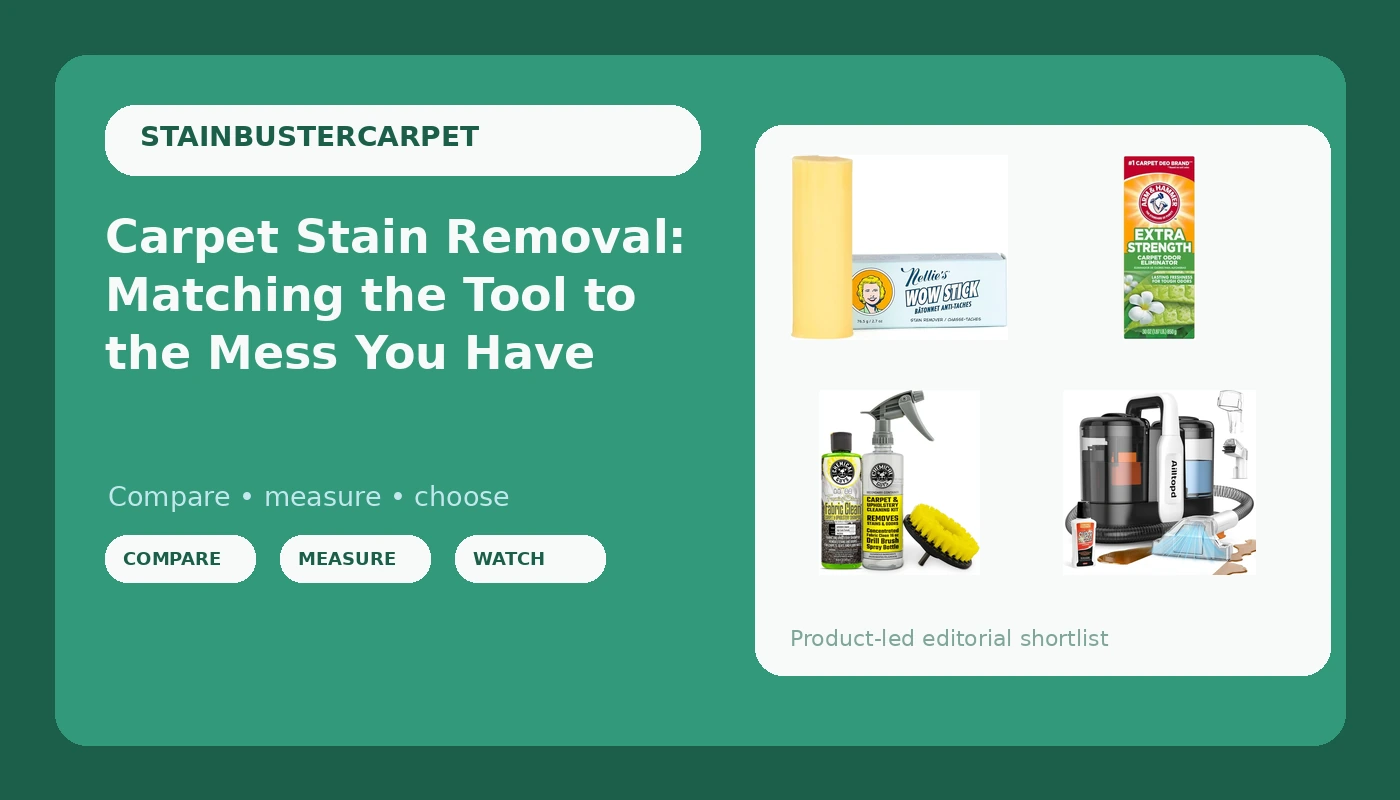
Carpet stain removal rarely fails because the cleaner was weak. It fails because the tool, the solution, and the timing were matched to the wrong kind of mess. A muddy footprint, a coffee ring, a pet accident, and a crayon mark are four different problems, and each one responds to a different combination of moisture, chemistry, and agitation. That is why a cupboard full of half-used bottles can still leave a shadow in the middle of a hallway.
This guide covers four products that between them handle most of those problems: a portable spot cleaning machine, a laundry stain stick used as a pretreatment, an extra strength carpet cleaning solution, and a citrus foaming cleaner positioned for drill brush agitation. None of them replaces the others, and the order in which you buy them matters more than the total you spend.
Related: How to Read a Dirty-Water Tank Before You Buy a Carpet Cleaner →
Quick answer
If you want one purchase that handles the widest range of fresh spills on carpet, stairs, upholstery, and car interiors, start with a portable spot cleaning machine, and the Ailltopd Portable Carpet & Upholstery Spot Cleaner Machine is the machine in this group. Everything else here is a supporting product. Nellie's WOW Stick pretreats food, protein, and body soil before it sets. Arm & Hammer Extra Strength Carpet Cleaners is a solution you mix into a machine tank or a bucket for larger areas. Chemical Guys Citrus Foaming Fabric & Carpet Cleaner covers the agitation step on greasy or ground-in soil. If you already own a working cleaner, buy the chemistry first and the machine later.
Four useful options
| Model | Best fit | What stands out |
|---|---|---|
| Ailltopd Portable Carpet & Upholstery Spot Cleaner Machine, 15Kpa Powerful Suction & Couch Cleaner, Deep Cleaning for Carpet, Car, Pets, Stairs, Furniture, Self Cleaning System and Cleaner Solution | Stairs, couches, car seats, pet accidents | A portable spot cleaner with a stated 15Kpa suction rating, a self cleaning system, and cleaner solution included |
| Nellie's WOW Stick | Laundry Stain Remover Stick | 2.7 oz |
| Arm & Hammer Extra Strength Carpet Cleaners (30 Oz) | Filling a machine tank or mixing a bucket | A 30 oz bottle of extra strength carpet cleaning solution |
| Chemical Guys, Citrus Foaming Fabric & Carpet Cleaner Drill Brush, 16 oz | Greasy and ground-in soil that needs agitation | A 16 oz citrus foaming cleaner sold for fabric and carpet surfaces |
The extraction tool: Ailltopd Portable Carpet & Upholstery Spot Cleaner Machine, 15Kpa Powerful Suction & Couch Cleaner, Deep Cleaning for Carpet, Car, Pets, Stairs, Furniture, Self Cleaning System and Cleaner Solution
The case for a portable over an upright is about where messes actually happen. Stairs, couch cushions, mattress edges, car seats, and the strip of carpet beside a dog bowl are all awkward for a full size machine, and those are the places stains start. A portable also gets used more often, because setup is a matter of filling one tank instead of dragging a heavy unit out of a closet. The trade-off is capacity and coverage: for an open living room with years of traffic soil, a portable means refilling and emptying repeatedly, and the pass you do today is a spot treatment, not a restoration. Judge this one the way you would judge any extractor. Weigh what comes out of the dirty tank, and clock how long the carpet stays damp, because a carpet that stays wet for two days is a bigger problem than the stain you started with.
The pretreatment: Nellie's WOW Stick | Laundry Stain Remover Stick | 2.7 oz
A stick is not a carpet cleaner, and treating it like one leads to disappointment. What it does well is buy you time. A food or protein stain that gets a direct application within the first few minutes is far easier to remove later, whether the fabric ends up in the washing machine or under a spot cleaner. The format also keeps the product where you need it, which matters more than most people admit, since the best stain remover is the one that is within arm's reach when the glass tips over. Where it falls short is volume. A stick covers a small area, and a large spill or a whole cushion needs a liquid solution and extraction. Think of it as the first two minutes of the job, not the job.
The tank solution: Arm & Hammer Extra Strength Carpet Cleaners (30 Oz)
Solution is the line item people forget when they budget for a carpet cleaner, and it is the one that keeps costing money after the machine is paid for. A 30 oz bottle is a reasonable amount to keep on a shelf for occasional spot work, and it is the right shape of product for anyone running a portable machine that needs a tank filled. The caution is dilution and residue. Overdosing a tank leaves surfactant in the fiber, and surfactant attracts new dirt, which is how a carpet starts looking duller two weeks after it was cleaned. Follow the label ratio, and if the carpet feels stiff or sticky once dry, you used too much. This is also the product to skip if you have a machine with a proprietary cartridge system that only accepts its own solution.
The agitation step: Chemical Guys, Citrus Foaming Fabric & Carpet Cleaner Drill Brush, 16 oz
Agitation is the missing step in most home stain removal. Chemistry loosens soil and water carries it away, but something has to physically lift the soil off the fiber first, and a foaming cleaner paired with a brush does that on upholstery, car seats, and traffic lanes. Foam is useful here because it stays where you put it instead of soaking straight through to the backing. The trade-off is that this is a manual, hands-on product. It expects you to work it in and then remove the residue, and on a loose backed carpet or a fabric you have never cleaned, that means testing a hidden corner first. It is also not a substitute for extraction on a spill that has soaked into the pad. Use it for the greasy, ground-in, been-there-a-while soil that plain water just pushes around.
Prices and availability may change. Product images, names, and retailer links are matched to verified listings. No current price, rating, stock status, or measured result is stated here without current evidence.
Why carpet stain removal is a two-part problem
A carpet is a pile of fibers with air between them, and soil sits in three places: on top of the fiber, clinging to the fiber surface, and down in the backing and pad. Dry vacuuming handles the first. Chemistry handles the second. Extraction handles the third, and only extraction does. That is why a spray bottle alone tends to move a stain around rather than remove it, and why a machine run with plain water tends to wet the carpet without lifting much of anything.
The two parts have to match. A strong solution left in the fiber becomes a dirt magnet. A capable machine run with the wrong chemistry for the soil type pulls water but leaves the stain behind. The useful habit is to treat the machine and the solution as one purchase decision made twice, and to keep a pretreatment on hand for the small, fresh marks that never need the machine at all.
There is also a timing part that has nothing to do with equipment. Fresh stains come out. Set stains sometimes come out. Stains that have been ironed in by a hot dryer, baked by sunlight, or set by an earlier cleaning attempt with the wrong product often do not come out at all, and no amount of suction changes that. Recognizing which category you are in saves an afternoon.
How to match the product to the stain
Matching is a short process, and doing it in order prevents the most common mistake, which is adding liquid to a stain that should have been lifted dry first.
- Identify the stain class. Protein and food stains, tannin stains like coffee and tea, oil and grease, dye based marks, and dry particulate soil all respond to different chemistry, and the wrong one can set the mark.
- Check the fiber before the product. Most synthetic carpets tolerate water based cleaning well, while wool, viscose, and some natural fibers are more sensitive to moisture and agitation. If you do not know the fiber, test in a closet.
- Lift what is dry first. Scrape or blot solids and liquids before adding anything. Adding water to a solid spill spreads it deeper into the backing.
- Pretreat small, fresh marks with a stick and give the chemistry a few minutes. This is where a pretreatment does its best work, on a mark that has not dried yet.
- Extract, then deal with moisture. Run the machine over the area, empty the dirty tank, and get air moving across the carpet. Dry time is the number that decides whether the job was a success.
Building a routine without overbuying
- Buy for the biggest cleaning job you actually have, not the one you imagine. Most households need a portable and a bottle of solution, not a full size upright.
- Weigh the machine before you commit to it. If it is awkward to carry and annoying to empty, it will stay in the closet, and an unused machine cleans nothing.
- Keep the solution purchase separate from the machine purchase. Tank capacity and chemistry refills are ongoing costs, and cartridge systems lock you into one brand.
- Store a pretreatment where the messes happen. A stick in the kitchen drawer gets used in the first two minutes, which is when it matters.
- Test every new product on a hidden patch first, and never mix two cleaning chemicals together hoping for a stronger result.
Which option should you choose?
Choose the Ailltopd Portable Carpet & Upholstery Spot Cleaner Machine, 15Kpa Powerful Suction & Couch Cleaner, Deep Cleaning for Carpet, Car, Pets, Stairs, Furniture, Self Cleaning System and Cleaner Solution when you need to pull liquid and suspended soil out of carpet, stairs, upholstery, or a car interior. Choose Nellie's WOW Stick | Laundry Stain Remover Stick | 2.7 oz when the mark is small, fresh, and on fabric you can treat on the spot, or when the same stain is on clothing or bedding as well as carpet. Choose Arm & Hammer Extra Strength Carpet Cleaners (30 Oz) when you need a solution to measure into a machine tank or a bucket for a larger area. Choose Chemical Guys, Citrus Foaming Fabric & Carpet Cleaner Drill Brush, 16 oz when the soil is greasy or ground in and needs agitation rather than more water.
One caveat applies to all four: none of them removes every stain, and no product should be judged on the ones that were never coming out. Dye stains, bleach damage, burns, and marks that have been set by heat are permanent changes to the fiber, not dirt sitting on top of it. Test in an inconspicuous area, follow the label directions for dilution and dwell time, and keep expectations tied to the type of stain rather than to the price of the bottle.
The bottom line
Carpet stain removal is a sequence, not a product. A pretreatment buys you the first two minutes, a solution loosens the soil, agitation lifts it off the fiber, and extraction carries it away in the dirty tank. If you are starting from nothing, the machine is the purchase that unlocks the rest, because it is the only item in this group that removes soil rather than loosening it. If you already own a cleaner, the solutions and the stick are the cheaper upgrades, and they are the ones that decide whether the next spill becomes a stain at all. Buy the piece you are missing, use it at the right dilution, and measure the result by what comes out of the tank and how fast the carpet dries.