Most carpet cleaning advice is written for somebody with a free weekend and a full-size upright in the garage. That is not most households. Most households have a staircase the dog treats as a napkin, a couch cushion that smells faintly of something nobody wants to name, and a hallway runner that has gone gray in the traffic lane. A portable spot cleaner for carpet handles that entire class of problem in about twenty minutes, without hauling forty pounds of machine up a flight of stairs.
I cleaned houses professionally for fifteen years and ran my own residential cleaning business for eight of them. I have cleaned more carpet than most people have walked on. The machine I reach for most often is not the big one in the closet. It is the small one with the hose and the two tanks.
What follows is the order of operations I actually use: what to buy, what to mix, how many passes to make, and the mistakes that leave a carpet damp for two days and smelling worse than it did before.
Why you should trust me
Every machine I test goes through the same three checks. I weigh the dirty-water tank before and after, because that tank is the only spec that cannot lie to you. I clock the dry time on the same carpet in the same room, because a wet carpet for two days is a mold factory, not a result. And I weigh the machine empty, because my back is the real review, and a cleaner that is miserable to carry gets used less and cleans worse.
I keep a logbook of which units pull the most water per pass. I do not publish a number I did not measure, and I do not tell you a machine removed a stain it did not remove. Some stains are furniture now. That is not a machine failure, and no bottle on the shelf will fix it.
What you need before you start
Gather everything before you plug anything in. The worst thing you can do is stop in the middle of a wet pass to hunt for a towel while the carpet soaks.
- The spot cleaner, filled and ready to go.
- Carpet cleaning solution, diluted exactly as the label instructs.
- A stack of white terry towels. White, because colored towels can bleed dye into damp carpet and you will not notice until it dries.
- A spray bottle of plain water for the rinse pass.
- A stiff nylon brush. Not wire, and not a scrub brush with hard bristles that will fuzz the pile.
- Nitrile gloves.
- A box fan, or two open windows on opposite sides of the room.
- A plastic bag for the used towels so they do not sit against anything.
The fan is not optional. It is the difference between a carpet that is walkable in three hours and a carpet that is still damp tomorrow morning.
Read the fiber before you touch the stain
Synthetic carpet, which is most of what is in American homes, is forgiving. Nylon and polyester will take a normal carpet solution and a normal amount of water without much complaint. Wool is not synthetic, and it is not forgiving. Wool plus too much water equals felting, and felted wool does not come back. Sisal and jute are worse, because they are plant fibers that can brown and shrink.
The test is simple. Find a corner behind a piece of furniture or inside a closet, spray a small amount of your mixed solution, wait ten minutes, and blot with a white towel. If the towel picks up color from the carpet, stop. That carpet needs a professional, not a Saturday project.
Colorfastness is the other thing people forget. Cheap solution with a high pH can strip dye, and stripping does not announce itself while the carpet is wet. It shows up two days later as a pale patch in the shape of your cleaning path. That is the kind of mistake you cannot undo.
The solution is part of the machine
Here is the part that gets buried under machine specs. A cheap machine with expensive solution is not cheap, and a good machine with the wrong solution leaves residue that attracts dirt. Residue is why a carpet looks gray again three weeks after you clean it. The dirt did not come back. You invited it.
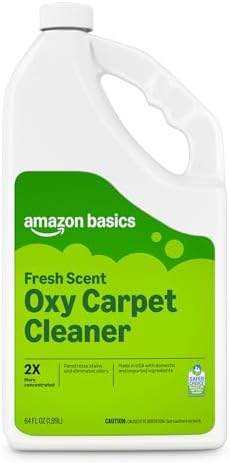
Solution pick: Amazon Basics Carpet Cleaner, Carpet Stain Remover, Fresh Scent, 64 fl oz, Packaging May Vary
 Visit on Amazon →
This is a 64 ounce bottle of carpet stain remover formulated for the dilution most portable machines expect, which means you are not guessing at a ratio meant for a different machine. Mix it to the label. Stronger is not better. A double-strength mix leaves a sticky film behind that grabs every bit of dust in the house, and you will be back on your knees in a month.
The fresh scent is a real preference decision, not a performance one. If anyone in the house reacts to fragrance, skip the scented route entirely and run plain water with a mild oxygen booster instead. And since the packaging may vary, do not assume the bottle matches the photo on the listing. Read the label that arrives and follow that label, not the one in your head.
Use it for the wet pass. Then run a second pass with plain water to lift the residue out. That second pass is the step almost everyone skips, and it is the reason their carpets look dull after a DIY cleaning.
Match the machine to the job
Buy for your biggest cleaning job, not your ideal one. If your biggest job is a staircase and a couch, a portable is the right call. If it is a 400 square foot living room with wall to wall, a portable will make you miserable by the third refill.
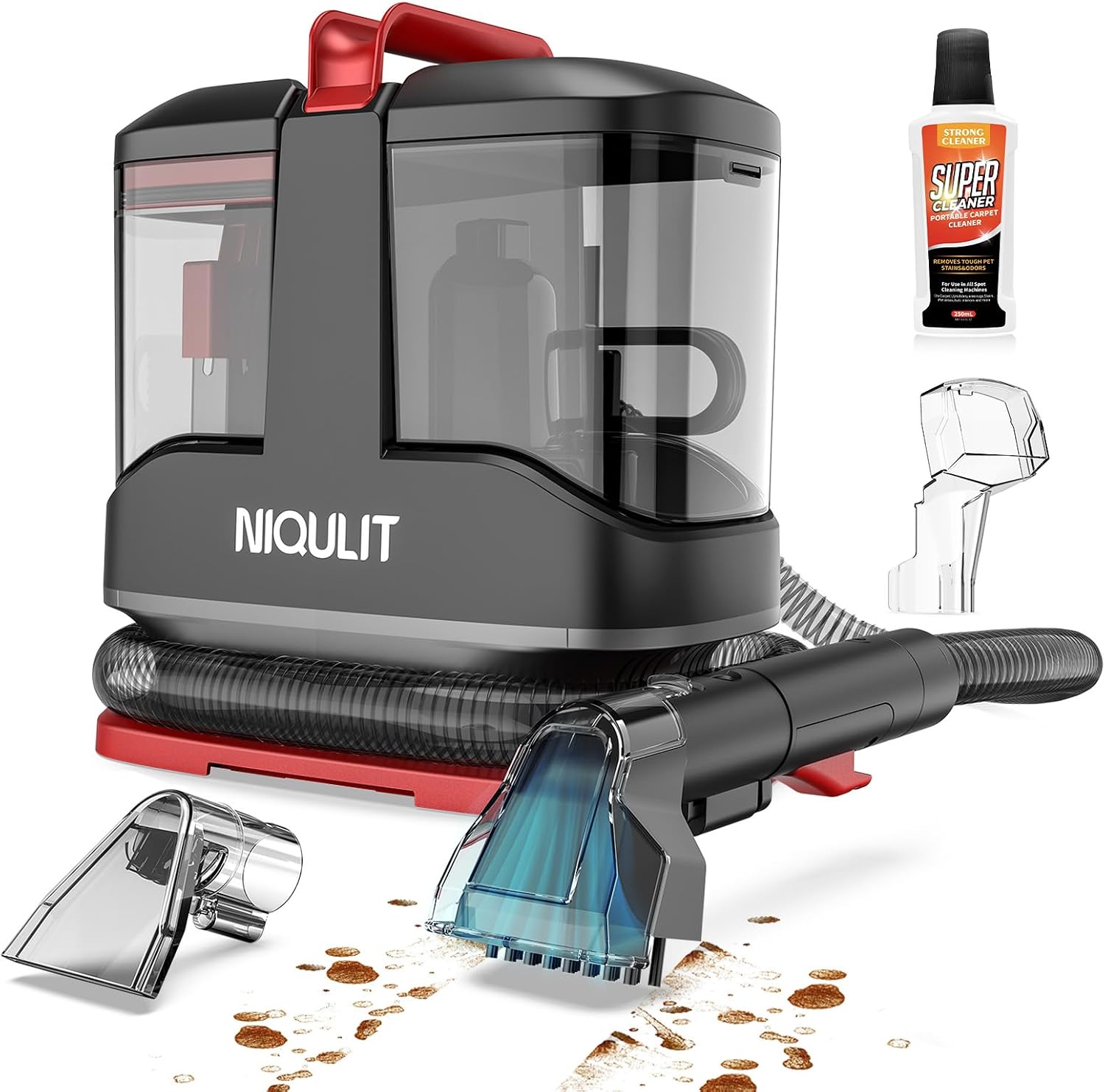
Machine pick: Portable Spot Cleaner Machine for Carpet and Upholstery - 15Kpa Deep Spot Cleaning for Area Rugs, Pets, Car, Couch Cleaner Machine with Dual Size BrushHead & Self-Cleaning System for Stairs/Furniture
 Visit on Amazon →
The 15Kpa suction rating is the number to care about, because recovery is what actually cleans. A brush that scrubs without lifting water just pushes the mess deeper into the pad. The dual size brush head matters more than it sounds. The wide head covers a stair tread or a seat cushion in a couple of passes. The narrow head gets into the crease where the tread meets the riser, which is where pet accidents collect and where a full-size upright physically cannot reach.
The self-cleaning system flushes the internal line after you finish. Use it every single time. A hose that holds dirty water between uses sours, and then every spot you clean afterward smells like the last one.
Flaws but not dealbreakers: The tanks are small, which is the tradeoff you accept for a machine you can carry with one hand. You will empty and refill more than you would with an upright. Budget for that in your time, not your patience.
Anyone cleaning stairs, upholstery, car seats, or a single bad pet stain will get the most out of this. Anyone cleaning an open floor plan should buy the upright and keep this for the stairs.
The workflow, step by step
Step one: vacuum dry, first. Loose soil plus water equals mud, and mud works its way into the backing where you cannot reach it. Vacuum the area thoroughly before any liquid touches it.
Step two: test the corner. Ten minutes, one white towel, as described above. Skip this and you are gambling the whole carpet on a hidden fiber blend.
Step three: pre-treat the spot. Spray the diluted solution on the stain and let it sit for five to ten minutes. Chemistry needs time. Scrubbing immediately just moves the stain around.
Step four: fill both tanks correctly. Solution in the clean tank, nothing in the dirty tank, and never overfill past the line. An overfilled clean tank sloshes solution into places it does not belong and floods the carpet.
Step five: make the wet pass slowly. One pass forward, one pass back, overlapping by half. Slow beats fast every time. The brush needs contact time to agitate, and the suction needs a moment to pull.
Step six: switch to plain water and rinse. Same slow passes with clean water. This is the residue step. Do not skip it, and do not use solution in this pass.
Step seven: dry strokes only. No trigger, just suction. Two or three passes over the same area with the machine pulling but not spraying. This is where you recover the water that would otherwise sit in the pad.
Step eight: blot and weight it. Lay white towels over the spot and stand on them. Your body weight pushes water up into the towel where the machine could not reach. Change the towels when they are saturated.
Step nine: move air. Fan on, pointed across the surface, not down into it. Cross-ventilation if you have it. Most spots are walkable in two to four hours with airflow. Without it, you are looking at overnight or worse.
Where a portable spot cleaner falls short
Open rooms. Big area rugs. Anywhere the square footage means four tank refills and a sore forearm. A full-size upright with large tanks wins those jobs outright, and pretending otherwise wastes your afternoon.
Cordless portables are their own trap. Fifteen to twenty minutes of runtime is enough for a car seat and one stair landing, and nowhere near enough for a hallway. If the battery dies mid-pass, you are left with a half-cleaned, fully soaked patch of carpet, which is the worst possible outcome.
And to be clear about a confusion I see constantly: a steam cleaner is not a carpet cleaner. Steam sanitizes a hard surface. It does not extract water from a pad. If your goal is a dry carpet, you need extraction, which means a dirty-water tank.
What this costs
I do not quote prices, because they move and the listing is the only honest source. What I will tell you is where the money actually goes over five years. The machine is a one-time purchase. The solution is not. Price the bottle before you price the machine, and do the math on how many cleanings a year you realistically do. The people who regret a cheap machine are usually the people who did not check what the refills cost.
Compare that annual number to a single professional carpet cleaning visit in your market. For a household with one staircase, one couch, and one dog, the break-even is fast. For a household with wall to wall carpet in six rooms, it is not, and you should hire someone twice a year and keep a portable for emergencies.
Common mistakes that keep carpet wet
Over-wetting is the number one problem. People see a stubborn stain, hold the trigger, and flood the area. More water does not equal more cleaning. It equals a wet pad and a wicking stain that reappears as a ring when it dries.
Skipping the rinse pass is number two. Leftover solution stays sticky, and sticky carpet gets dirty faster than clean carpet. You will blame the machine. The machine was fine.
Walking on it too soon is number three. Foot traffic on damp carpet crushes the pile and drives dirt into fibers that are still open. Wait until it is dry to the touch, not dry to the eye.
No airflow is number four. A closed room with no fan holds moisture for a day and a half. That is how you get the smell people describe as "wet dog" when there was never a dog.
And number five: expecting perfection. Old stains, dye stains, and anything that has been set by heat will not come out. Clean what will come out, dry it fast, and leave the rest alone. Some stains are furniture now, and that is a fine outcome.