Most pet stains do not come back because the stain was impossible to remove. They come back because the water never left, the odor source stayed in the pad, and the chemistry was wrong for the fiber. I have watched a carpet look spotless for four days and then announce itself in August heat like nothing had ever been cleaned.
Carpet cleaning for pet stains is really three jobs stacked on top of each other: lifting the waste out of the fiber, killing the odor at its source so the pet does not re-mark the same spot, and getting the carpet dry fast enough that nothing grows in it. Miss any one of those three and you will be doing the job again next month.
This is the order that works, the two tools that make each step easier, and the mistakes that turn a thirty-minute job into a carpet replacement.
Why you should trust me
I am Vera. I have cleaned carpets professionally for 15 years, eight of them running my own residential cleaning business in Phoenix, and I have pulled more dirty water out of carpet than most people will walk across in a lifetime. Every machine I look at gets the same three tests: the dirty-water tank weighed before and after a pass on a genuinely soiled carpet, a dry-time clock on a measured section, and a weight check when I lift it in and out of a truck.
The dirty water tank is the honest spec. It tells you what the machine actually pulled up, not what the box promises. Dry time is the second honest spec, because a carpet that stays wet for two days is a mold factory no matter how good it looked when you finished. Weight is the third, because the machine that hurts your back is the machine that stays in the garage while the stain sets.
How I picked and how I tested
Two tools cover almost every pet stain job in a normal house: a full-size upright that can flush and extract a whole room, and a concentrated oxygen-based formula that breaks down the stain and the odor before the machine ever touches it.
I judge carpet cleaners on recovery first, which is how fast the brush roll and the suction path lift water back out of the fiber. Then dry time. Then whether I can carry it up a flight of stairs without stopping halfway. For solutions, I judge on residue, because a formula that foams and leaves soap behind will pull dirt back into the carpet within a week and leave it crunchy underfoot.
Both products below earned their place on that short list. One handles the extraction, the other handles the chemistry.
What you need before you start
You need four things: a machine that extracts water rather than just agitating it, a formula built for organic stains, white towels you do not care about, and airflow. The machine and the formula are the two that people get wrong most often.
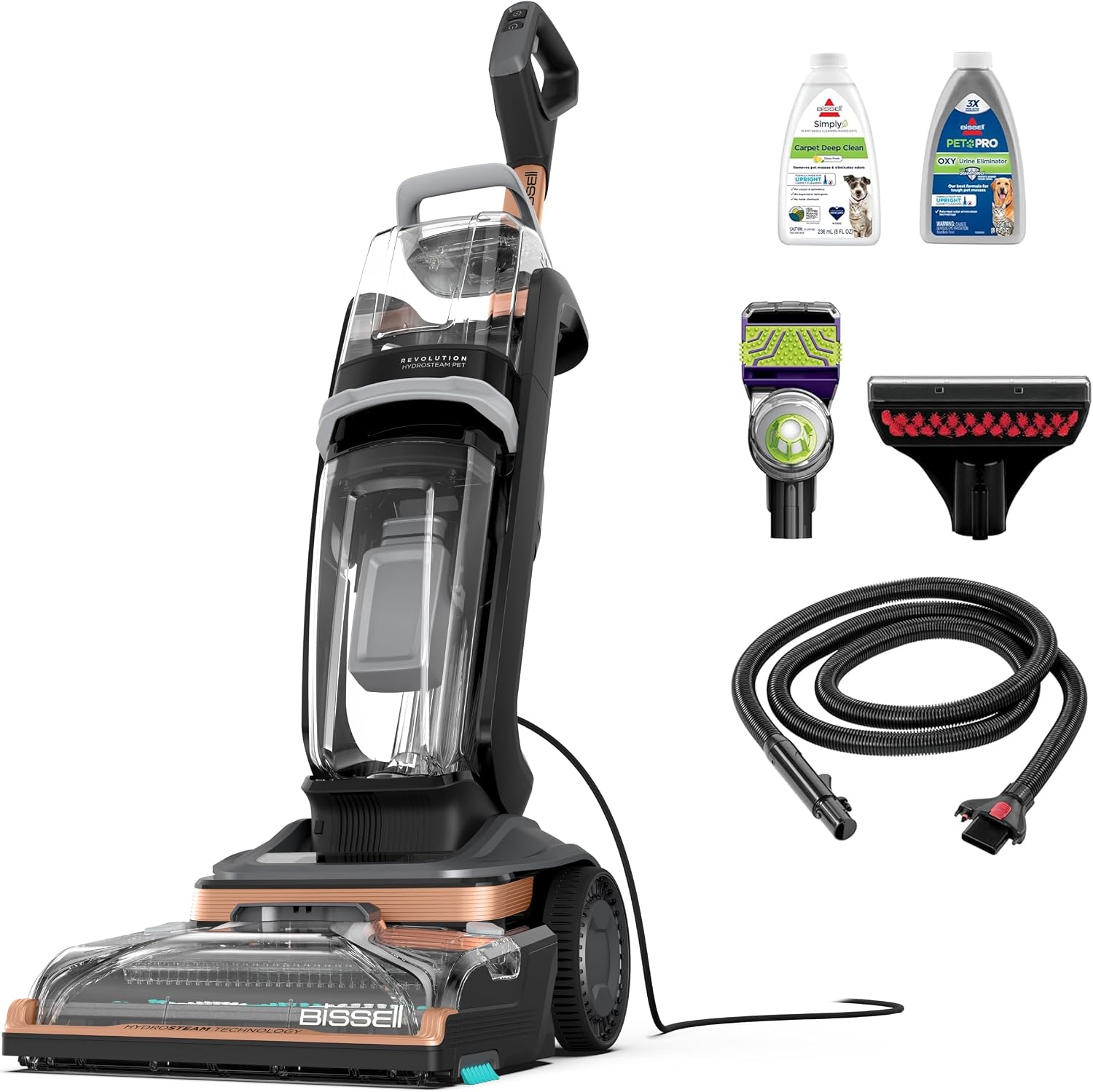
The extraction machine: BISSELL Revolution HydroSteam Pet Carpet Cleaner, 3432
 Visit on Amazon →
This is the full-size upright I would put in a pet-heavy house. Check current Amazon price.
The reason it belongs in this guide is the heated water. Hot water is not a gimmick when the stain is pet waste. Dried protein and urine salts release faster in warm water than in cold, and warm water also helps the carpet dry faster, because you are not leaving a cold, heavy soak sitting in the backing. The pet-specific tooling matters too. A crevice tool for stairs and upholstery and a wide cleaning path for open rooms are two different jobs, and you want both on the same machine instead of buying a second unit for the staircase.
It is also a full-size machine, which means a real dirty-water tank and a real clean-water tank rather than the thimble-sized reservoirs you get on handhelds. When you are doing a whole room, tank size decides whether you finish the job or spend half of it walking to the sink.
Flaws but not dealbreakers: It is heavy and it takes up closet space. If your entire pet problem is one armchair and one hallway runner, this is more machine than you need, and a portable spot cleaner plus a bottle of formula will serve you better.
Anyone with carpet in more than one room, a dog or two cats, and a hallway that takes the worst of it should start here.
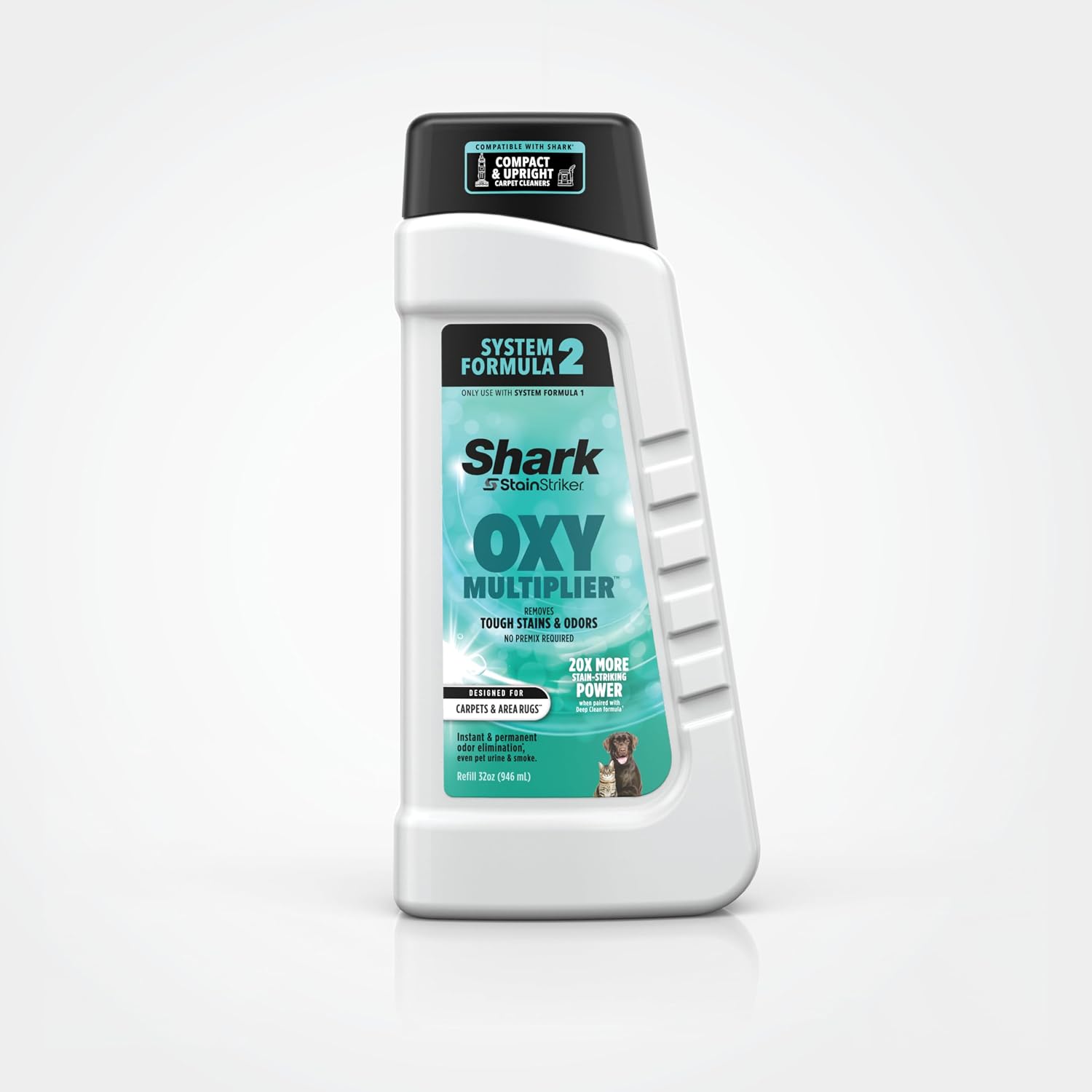
The pre-treatment formula: Shark StainStriker OXY Multiplier Formula for Tough Stains/Odor XSKEXOX32B
 Visit on Amazon →
This is the chemistry half of the job. Check current Amazon price.
An oxygen-based multiplier is what I reach for on the stains that have been sitting: old urine spots, vomit that dried before anyone noticed, the dark ring that forms around a water bowl. Oxygen works on the organic material that causes both the stain and the smell, and it does it without the chlorine smell that makes a room unlivable for an afternoon. If you have ever cleaned a carpet with a bleach-adjacent product and then had to open every window in the house, you understand why that matters.
The other reason I keep an oxygen formula in the kit is residue. A formula that rinses clean means the carpet does not grab dirt back out of the air a week later. Mix it at the ratio printed on the bottle, not stronger. More concentrate is not better here. A heavy mix is the fastest way to leave a sticky film behind, and that film attracts soil like a magnet.
Flaws but not dealbreakers: It is a consumable, so it runs out at the worst possible moment. Buy it before you need it, not the night before guests arrive.
Anyone spot-treating before a full machine pass, or maintaining carpet between deep cleans, gets the most out of it.
The actual stain removal workflow
Now the part you came for. This order works on fresh accidents and on the ones you just discovered behind the couch.
Step one: Identify the fiber. Wool, nylon, polyester, and olefin all behave differently. Wool is the delicate one and it does not like high heat or strong alkalinity. Before you touch the spot, test your formula on a hidden corner, like the carpet inside a closet, and give it ten minutes. If the color transfers to your white towel, stop and call a professional.
Step two: Blot, never rub. Rubbing drives contamination into the backing and fuzzes the fiber tips so the spot looks worn forever, even after it is clean. Press white towels down and stand on them. Let the towel do the work and swap to a dry section as it loads up.
Step three: Pull the water before you add chemistry. For a fresh accident, extraction comes first. Fresh urine is mostly water and it is easy to lift while it is still liquid. If you flood a fresh puddle with heavy solution, you turn a liquid you could have vacuumed out into a liquid you now have to rinse out, and you have doubled the drying time.
Step four: Pre-treat the old stuff. For dried stains, mix the oxygen formula, apply it, and let it dwell for ten to fifteen minutes. Do not let it dry on the fiber. If it starts to dry, mist it again. The dwell time is doing the actual work here, not the scrubbing.
Step five: Run the machine slowly. One wet pass forward, one back, overlapping the previous path by a few inches. Speed is the enemy. The brush needs contact time with the fiber and the suction needs a moment to grab the water you just laid down. Fast passes feel productive and leave the carpet soaked.
Step six: Dry passes with the trigger released. Two or three passes over the same area with no solution going down. This is the step everyone skips and it is the reason carpets stay wet for two days. The dry pass is where the machine earns its keep, because it is pure recovery.
Step seven: Get air moving. Fans, open windows, air conditioning, whatever you have. Aim for walkable in a few hours and fully dry by the next morning. If you can put a fan directly on the damp section and leave it running overnight, do it.
Step eight: Treat the source, not just the spot. Odor lives in the pad and sometimes in the subfloor. If the smell comes back after the carpet dries, the contamination is below the carpet. That means pulling the carpet back, treating the pad, replacing the pad if it is saturated, and sealing the subfloor before the carpet goes back down. Re-stretching is a job for a pro, but diagnosing it is something you can do yourself by lifting a corner and sniffing.
The mistakes that cost the most
Over-wetting is the number one killer. More water does not mean more clean. It means a longer dry time, a deeper soak into the pad, and a much higher chance of odor coming back.
Mixing cleaners is the second. Bleach plus ammonia products, or an oxygen formula dumped into a tank that still has detergent in it, can produce fumes or cancel out both products. Rinse the tank and mix one thing at a time.
Skipping the dry pass is the third. It is the least satisfying step and the one that determines whether the carpet is dry tonight or damp on Thursday.
Treating only the visible spot is the fourth. Urine spreads outward and downward, so the stain you can see is often smaller than the contaminated area. Treat a ring a few inches past the visible edge.
Expecting a steam mop to do this job is the fifth. A steam cleaner and a carpet cleaner are different tools. Steam adds moisture and heat, but it does not extract, and extraction is the whole point.
Not neutralizing the odor is the sixth, and it is the one that brings the pet back. If the spot still smells like a bathroom to your cat, your cat will use it again.
When to stop cleaning and replace the carpet
Some carpets are furniture now. If the pad is saturated through to the subfloor, if the backing has delaminated and the carpet ripples when you walk on it, or if the odor returns within a week of every cleaning, you are fighting a losing battle with chemistry.
That is not a failure of method. It is a failure of material. Carpet has a lifespan, and a decade of repeated pet accidents is past it. In that case, the money you would spend on a third round of formula is better spent on new carpet and a good pad, and the machine you already own will keep the new one clean.
What this costs in real terms
The honest answer is that the tools cost less than the mistake. One extraction machine and one bottle of oxygen formula handle years of accidents, and the formula is the only recurring cost. Compare that to a professional deep clean every time something happens, or to replacing a room of carpet because the odor won.
The machine is the bigger purchase, and it is the one to get right, because the wrong machine gets used once. Check current Amazon price on the BISSELL if you have a whole house of carpet, and check current Amazon price on the Shark formula if you already own an extractor and just need the chemistry. If you are not sure which problem you have, buy the formula first. It is the cheaper test, and it will tell you fast whether the stain is surface-level or whether you are looking at a pad problem.
Add towels you already own and a fan you already own, and the whole setup is done.
The short version
Blot before you scrub. Extract before you treat. Pre-treat with oxygen and give it time. Run the machine slow, then run it again with no solution. Dry it with air, not with hope. And if the smell comes back, stop cleaning the carpet and start looking at the pad underneath it.
That order is the difference between a spot that disappears and a spot that becomes a habit. Your carpet is a surface with a finite number of cleanings in it. Spend them on the right sequence.