Most carpet cleaning advice starts with the machine. Mine starts with a bathroom scale. If you want to know how to deep clean carpet and have it dry by dinner, the number that matters is what the machine pulls out of the fibers, not how much soap you put in. I have cleaned carpets in Phoenix for fifteen years, eight of those running my own residential cleaning business, and I have never once been impressed by a suction rating on a box. I have been impressed by a dirty water tank that comes out heavy.
This is the workflow I use on client carpets, plus the two machines I would actually put on my own stairs and the mistakes that turn a clean carpet into a wet, smelly problem.
Why you should trust me
I have cleaned more carpets than most people have walked on. My logbook goes back years, and every entry has the same three numbers: the weight of the dirty water tank, the hours until the carpet was walkable, and how my back felt after hauling the machine up a flight of stairs. Those three numbers have talked me out of more machines than any spec sheet ever did.
I do not write about machines I have not put on a real stained carpet. I do not test with clean water on a clean rug, because that tells you nothing. And I will not tell you a carpet cleaner removes every stain, because some stains are furniture now.
How I judge a carpet cleaner
Four things, in this order.
Recovery. How fast the brush roll and the vacuum shoe lift water back out of the pile. You can feel it in the handle. A machine with real recovery fights you a little as it grabs the carpet. A machine with weak recovery glides, and that glide is the sound of water staying in your pad.
Dry time. The spec nobody advertises. Wet carpet for two days is a mold factory, and mold is a much bigger bill than a carpet cleaner. A carpet that is dry to the touch in four to six hours is a carpet that was cleaned properly.
Weight. A thirty-pound machine that hurts to haul gets used less, and a machine that gets used less cleans worse than the one you actually pull out of the closet. Weight is a feature, not a compromise.
Solution cost. The cleaning solution is part of the machine. A cheap machine that only runs well on expensive detergent is not cheap.
What to do before the machine comes out
None of this is optional, and all of it takes less time than the cleaning itself.
Vacuum first, twice. Dry soil is most of what is in your carpet. If you wet it before you vacuum it, you make mud, and mud works its way deeper into the backing. Two slow passes, different directions.
Know your fiber. Nylon and polyester are forgiving. Olefin is prone to wicking. Wool is a different conversation and often wants a low-moisture method rather than a full flood. Check the manufacturer care tag or the fiber guide before you commit.
Test a hidden corner. One square foot under a sofa. Let it dry completely before you judge it. Colorfastness problems show up after drying, not during.
Pre-treat the traffic lanes. Give the pre-treatment time to dwell per its label. Working it in with a brush does more than spraying and immediately sucking it back up.
Move everything and ventilate. Furniture legs, plants, the cat. Open windows if the outside air is dry, and run a fan regardless.
The two machines I would put on a real staircase
Full-size uprights win in open rooms. Portables win on stairs, couches, and car interiors. Most homes need one of each, or one machine that can do both jobs without making you hate the stairs.
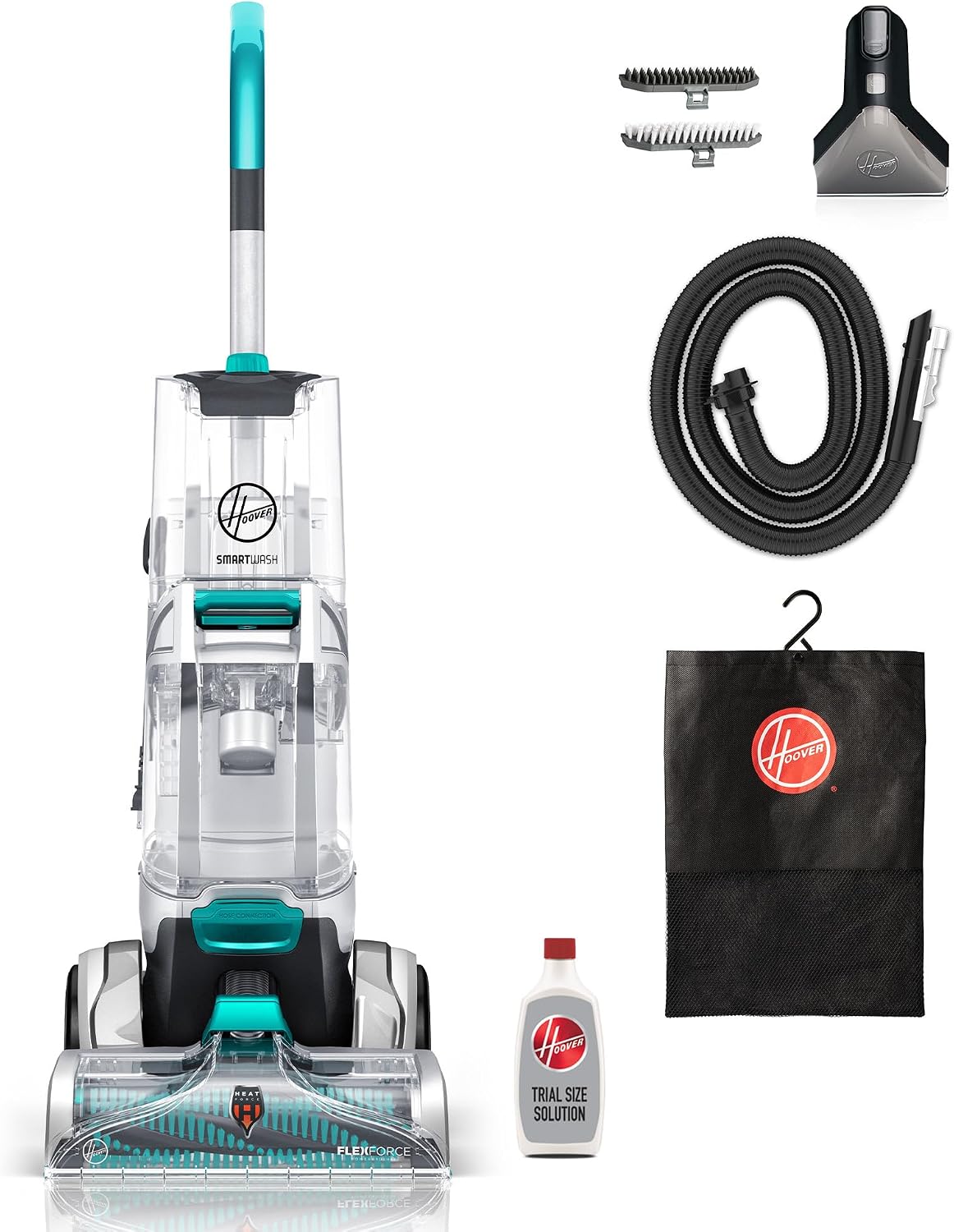
Best for beginners: Hoover SmartWash Automatic Carpet Cleaner, FH52000 (Renewed)
 Visit on Amazon →
The reason I hand this machine to first-timers is the trigger. On most cleaners you mix the solution yourself, and most people mix it too strong, which is how you get foam, residue, and a carpet that resnaps dirty in three weeks. The SmartWash does the mixing for you, so that failure mode is much harder to reach. Push forward to clean, pull back to dry, and the machine handles the ratio.
It is also a full-size upright with a dirty water tank you can actually empty without baptizing the hallway, which is a lower bar than it should be in this category. The renewed listing means it is a factory-refurbished unit rather than a new one, so inspect it on arrival, run it on a scrap of carpet before you commit to the living room, and check the warranty terms on the listing. Check current Amazon price, since renewed stock moves around.
Flaws but not dealbreakers: It is a full-size machine, so stairs are a haul, and it wants floor space in storage. If your cleaning is mostly staircase, read the next section.
Anyone cleaning a whole room or a whole floor who does not want to think about solution ratios will be happy here.
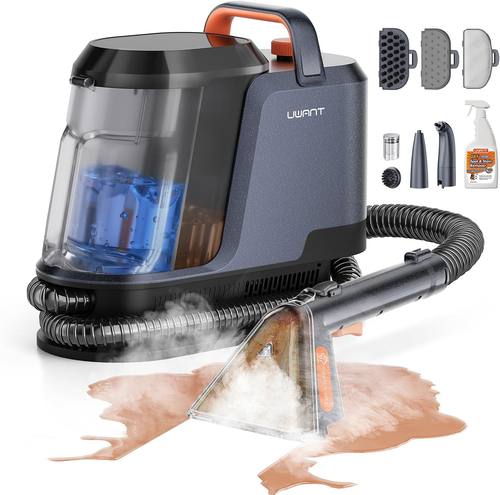
Best for stairs and upholstery: Uwant Carpet Cleaner Machine with Steam&Hot&Cold Water Models 18Kpa Powerful Suction Upholstery Cleaner Machine with Pet Pro Cleaner for Pets, Carpet Steam Cleaner Set of 1
 Visit on Amazon →
This one earns its place on the stairs and the couch. Smaller body, easier to carry up a flight, and it reaches the places a full-size upright physically cannot, which is where most pet accidents actually happen. The pet-focused attachments are the point for households with animals.
One honest note about the name: steam and hot water extraction are not the same tool. Steam refreshes, loosens surface soil, and helps with odors, and it is genuinely useful on upholstery. Deep cleaning carpet means hot water extraction, which is what lifts the soil out and into the tank. Use the hot water mode for the deep clean and the steam for touch-ups and the couch, not the other way around. This machine covers both, which is why it travels with me.
Small tanks are the trade-off for the size, so plan on refilling per room and empty the dirty tank before it hits the full line. Check current Amazon price on the listing for the current configuration.
Flaws but not dealbreakers: Small tanks mean more trips to the sink. On a whole open floor, a full-size upright finishes faster.
Anyone with pets, stairs, or a car interior that needs the same treatment will get more use out of this than a big upright.
The workflow, step by step
Step one: fill with the hottest water your machine allows, and measure the solution. More solution is not more clean. Over-dosing leaves sticky residue that grabs dirt faster than before. If you see foam in the dirty tank, you used too much.
Step two: start at the far corner and work toward the door. You want to walk out of the room, not across a wet field.
Step three: one wet pass forward, one dry pass back. The wet pass lays down water and solution. The dry pass, with the spray off, is the one that actually cleans, because it is the one that recovers. Most homeowners do three wet passes and no dry passes, which is exactly backwards.
Step four: overlap each pass by about a third. Skip the overlap and you get stripes that reappear as the carpet dries.
Step five: slow down. The brush roll needs contact time. Fast passes look productive and recover almost nothing.
Step six: empty the dirty tank before it is full. A full tank loses suction and starts spitting. Dump it in a utility sink or outside, not in a kitchen sink you have to scrub afterward.
Step seven: dry the room on purpose. Fans on, ceiling fan on, windows open if the outside air is dry. In Phoenix, a cleaned carpet is often dry to the touch in four hours. In a humid climate, add a dehumidifier and give it eight. If it is still damp the next morning, you overwet it.
Step eight: groom the pile. A carpet rake or a stiff brush restores the nap and helps the fibers dry evenly.
The mistakes I see most
Cleaning without vacuuming. Dry soil first, always. It is the cheapest step and the one that decides how the rest goes.
Flooding a stain. A stain that has been wet for a week is harder to remove than one you treat and extract in ten minutes. Blot, do not scrub.
Using rental detergent in a machine you own. Rental solutions are formulated for rental machines and often foam heavily in a home unit. Foam means residue, and residue means the carpet looks dirty again in a month.
Cleaning the whole room when the traffic lane was the problem. Spot-clean the lane, deep clean the room twice a year, and you will get more life out of the carpet than a monthly flood.
Leaving furniture on wet carpet. Rust stains and dye transfer. Foil or plastic under the legs, or move it out of the room.
What this actually costs you
I am not going to quote a sticker price, because renewed stock and bundle configurations move and a number in an article goes stale fast. Check current Amazon price on each listing instead, and weigh that against what you would spend renting a machine three times, buying the rental detergent each time, and losing a Saturday to it.
The real cost is the solution and the time. Budget solution as a running cost, not a one-time one. Budget two hours for a normal room, more for stairs, and plan the day around drying time rather than around cleaning time.
The short version
Vacuum twice. Know your fiber. Pre-treat. Use hot water extraction with the correct amount of solution, one wet pass and one dry pass, overlapping. Empty the dirty tank before it fills. Dry the room on purpose and groom the pile. Weigh your dirty water tank once, and you will never trust a suction number on a box again.