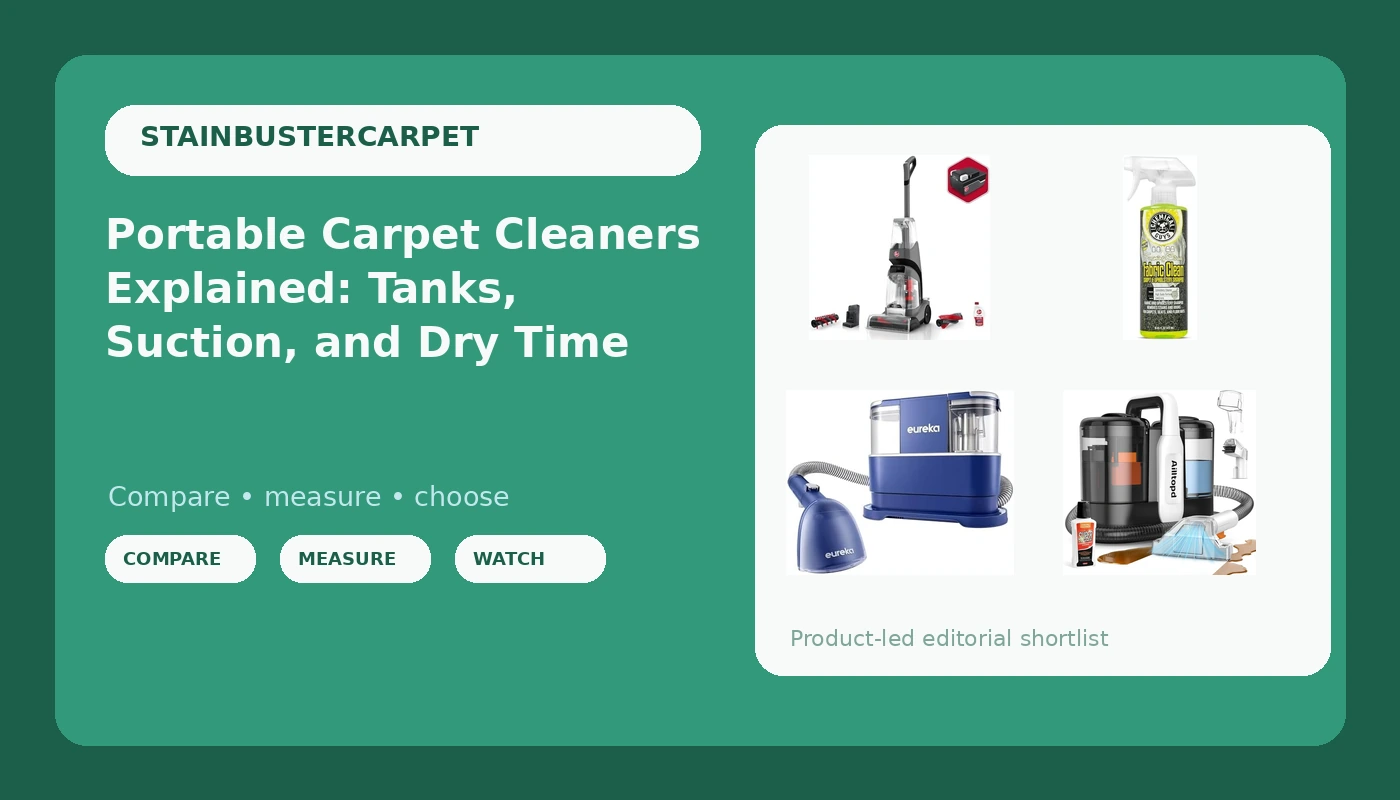
A full-size upright is the right tool for an open room and the wrong tool for a staircase. Portable carpet cleaners exist for everything the big machine cannot reach: the steps, the couch cushions, the car's back seat, and the three square feet where the dog had an accident before sunrise. The trade-off is real. Smaller tanks mean more refills, cordless designs mean a battery to manage, and every wet pass leaves the carpet damp for hours you have to plan around.
This guide covers four different answers to that same problem: a cordless machine, a large-tank portable, a compact spot cleaner, and a spray bottle that needs no setup at all. None of them replaces a full-size extractor for a whole house. All of them handle the jobs people actually put off.
Related: How to Clean Stairs and Upholstery Without Soaking Them →
Quick answer
For stairs, upholstery, and car interiors, a portable machine with a recovery tank you can carry and empty one-handed will get used more often than a full-size upright, because the machine you actually pull out of the closet is the machine that cleans. If your messes are small, fresh, and mostly on fabric you cannot remove, a ready-to-use fabric and carpet spray is the least involved option, since it needs no water hookup, no mixing, and no setup. The deciding factors are tank volume, corded versus cordless operation, and how much damp time the surface can tolerate.
Four useful options
| Model | Best fit | What stands out |
|---|---|---|
| Hoover ONEPWR SmartWash Cordless Carpet Cleaner Machine | Stairs, landings, and quick passes without an outlet | Cordless ONEPWR design with no power cord to manage |
| EUREKA Portable Carpet and Upholstery Cleaner, Spot Cleaner for Pets, NEY100 | Longer sessions on rugs, couches, and car seats | 50.7 oz water tank and cleaning formula included |
| Ailltopd Portable Carpet & Upholstery Spot Cleaner Machine | Tight spots, stairs, furniture, and pet messes | 15Kpa listed suction rating and a self-cleaning system |
| Chemical Guys, Citrus Fabric & Carpet Cleaner, Ready-to-Use Spray, 16 oz | Small, fresh marks on fabric you cannot remove | Ready-to-use citrus spray in a 16 oz bottle |
Cordless all-rounder: Hoover ONEPWR SmartWash Cordless Carpet Cleaner Machine
The cordless trade is run time. A battery machine gives you freedom from outlets and a hard ceiling on how many stairs you can finish before you stop, and that ceiling is usually lower than people expect when they picture cleaning a whole staircase. The sensible way to use one is as a spot and stairs machine that lives charged and ready, not as a replacement for a corded unit on a full room. If your cleaning is spread across the week in ten-minute bursts, that model fits well. If it is one big Saturday project, a corded machine will not leave you standing on the landing waiting.
Large-tank portable: EUREKA Portable Carpet and Upholstery Cleaner, NEY100
Tank size is the spec that decides how long you can work without a break, and a 50.7 oz tank pushes that break further out than most portables in this class. The catch is weight in the worst state: a portable is heaviest when both tanks are full, and that is exactly when you carry it up the stairs. Empty the recovery tank the moment you pause, and the machine stays manageable. This is the one to look at if your cleaning sessions run long, such as a sectional couch, a full flight of steps, or the back row of a minivan.
Compact spot machine: Ailltopd Portable Carpet & Upholstery Spot Cleaner Machine
A suction rating is a number on a box, not a result on your carpet. What a machine actually lifts depends on the brush or nozzle, how slowly you pass it, how wet the fabric already is, and whether you follow the wet pass with enough dry passes to pull the water back out. A 15Kpa figure tells you the machine is designed to move air hard at the nozzle, which matters most on the surfaces where water likes to sit: dense upholstery, car seats, and the nap of a low-pile stair runner. The self-cleaning system is the practical detail, since a spot machine that is annoying to flush out is a spot machine that sits unused.
Ready-to-use spray: Chemical Guys Citrus Fabric & Carpet Cleaner
Sprays and extractors do different jobs, and confusing them is how people end up with a stain that keeps coming back. A spray loosens and lifts what sits near the surface of the fibers. Without extraction, whatever you loosened is still in the carpet, and as it dries it can wick back up to the tips, which is why a spot looks gone and then reappears two days later. The fix is technique: spray, wait the time the label allows, blot with a clean white towel, and repeat with plain water to rinse. For a fresh coffee drip or a muddy footprint, that is often enough. For anything that has reached the backing or the pad, you want water extraction.
Prices and availability may change. Product images, names, and retailer links are matched to verified listings. No current price, rating, stock status, or measured result is stated here without current evidence.
How recovery and dry time actually decide the outcome
The dirty water tank is the honest spec. It tells you what the machine pulled out of the carpet, not what the marketing copy promised. Water goes in, water comes out, and the difference is what stayed behind. That is why the useful habit is to check the recovery tank after every few passes: if it is coming out nearly clear on a carpet you know is dirty, the machine is not lifting much, and you are mostly wetting the fibers.
Dry time is the spec nobody reads until it matters. A carpet that stays damp for a day or more is a problem, not a result, and it is how a small spill turns into a smell. Everything that shortens dry time helps: slower dry passes with the machine, a fan or open window, and not over-wetting in the first place. Two light wet passes and four dry passes will usually beat one heavy soaking pass, because the machine can only pull back the water it can reach.
Suction ratings are measured at the nozzle, not at the carpet. A high number describes airflow at the opening, and by the time that airflow reaches a wet pad through dense upholstery, a lot of it is gone. Tank size is the other number people misread. A bigger tank does not clean better; it just means fewer trips to the sink, which is a genuine convenience on a staircase and almost irrelevant on a single couch cushion.
Solution chemistry deserves the same skepticism. More detergent is not more cleaning. Leftover soap residue stays in the fibers, attracts new dirt, and makes the carpet feel stiff. Carpet-specific solution, dosed per the label, plus a plain-water rinse pass is the combination that leaves the least behind.
Matching the machine to the job
Think about the biggest single cleaning job you will actually do, not the ideal one. A stairwell and a couch are portable jobs. An open living room is an upright job. A car interior is a portable job with a hose and a small nozzle. Most households overbuy for the room and underbuy for the stairs, then discover the big machine does not fit on a tread.
- Measure the biggest job. Count stair treads, couch cushions, and car seats. That total decides whether tank size matters.
- Decide corded or cordless. Cordless wins on stairs and in cars; corded wins on long sessions with no run-time ceiling.
- Weigh the machine full. A portable is heaviest with both tanks loaded, and that is the state you carry it in.
- Plan the dry time. If the room cannot stay open for several hours, do less water per pass and add airflow.
- Decide whether you need extraction at all. Fresh, surface-level marks can be handled with a spray and a towel.
Practical guidance
- Empty the recovery tank before it hits the max line, since an overfilled tank is the most common way these machines spill.
- Use a carpet-specific solution at the dose on the label, and keep a plain-water rinse pass in the routine.
- Do fewer wet passes and more dry passes; the dry passes are where the water actually leaves the carpet.
- Test any spray or solution on a hidden area first, especially on wool, sisal, and anything with a colorfastness warning.
- Keep a stack of clean white towels for blotting, because a colored towel can transfer dye onto a damp carpet.
- Let the carpet dry fully before walking on it, and lift furniture legs onto foil or plastic while it dries.
Which option should you choose?
Choose the Hoover ONEPWR SmartWash Cordless Carpet Cleaner Machine when you want to grab a machine and go without hunting for an outlet, and your jobs are short bursts on stairs, landings, and small rooms. Choose the EUREKA Portable Carpet and Upholstery Cleaner, NEY100 when your sessions run long and the 50.7 oz tank plus the included formula means fewer refills and fewer extra purchases. Choose the Ailltopd Portable Carpet & Upholstery Spot Cleaner Machine when you want a compact, purpose-built spot cleaner with a listed 15Kpa suction rating, a self-cleaning system, and solution in the box. Choose the Chemical Guys Citrus Fabric & Carpet Cleaner when the mark is small and fresh and you would rather spray and blot than fill a tank.
One caveat applies to all four. Nothing here removes every stain, and nothing here changes the fact that some marks are permanent. Old dye-based spills, bleached spots from a previous cleaner, and anything that has set through heat can be beyond recovery. Test on a hidden area, work from the edge of the stain inward, and accept that a faded patch is sometimes the honest end state.
The bottom line
Match the tool to the job and the job gets done. A cordless machine removes the friction that stops you from cleaning a stain the day it happens. A large-tank portable keeps you working without trips to the sink. A compact spot cleaner with a self-cleaning system is the one you will not dread flushing out. A ready-to-use citrus spray handles the small, fresh marks that never needed a machine. Check current Amazon price on the ones that fit your biggest job, and judge the results by what comes out in the dirty water tank rather than what the box promised.